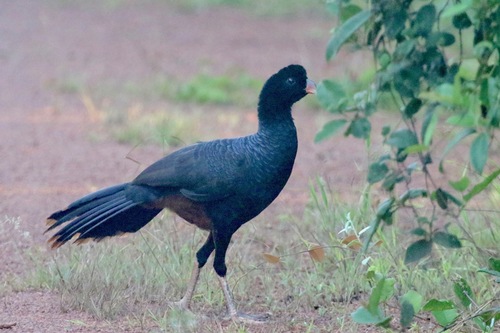
Crestless Curassow
Mitu tomentosum
A shy giant of the South American understory, the Crestless Curassow is famous for its glossy black plumage and its lack of the traditional curly crest. This elusive ground-dweller is a prized find for any backyard observer near the Amazonian riverbanks.
Quick Identification
Size
75–84 cm (30–33 in) in length; weighs approximately 2–3 kg (4.4–6.6 lbs)
Colors
Glossy black plumage with a bluish-purple sheen; rich chestnut-brown belly and vent; orange-red bill and legs
Key Features
- Smooth, flat crown lacking the typical curly crest of other curassows
- Deep chestnut-colored lower belly and undertail coverts
- Bright reddish-orange bill with a slightly swollen base
- Tail feathers tipped with a distinct buff or pale-brown band
When You’ll See Them
Geographic range
Where Does the Crestless Curassow Live?
Native to the northern reaches of South America, the Crestless Curassow is a quintessential resident of the Amazon and Orinoco river basins. Its core population resides in the dense humid forests of Brazil, Colombia, Guyana, and Venezuela, typically sticking to low-lying areas near water sources. Unlike some wide-ranging birds, this species remains localized within these pristine riverine environments and hasn't been introduced to other continents.
Basemap © OpenStreetMap contributors
Behavior
The Crestless Curassow is a secretive, primarily ground-dwelling bird that moves with a deliberate, almost stately pace through the tropical understory. While they spend the majority of their time on the forest floor searching for fallen fruit, they are capable flyers and will retreat into the mid-canopy to roost at night or to escape potential predators. They are often detected by their deep, resonant booming calls, which are most frequent during the early morning hours and can travel significant distances through the dense vegetation.
Socially, these birds are typically observed in pairs or small family groups. They are notoriously wary of human presence and will quickly slip into thick cover if they sense movement. In the wild, they play a vital role in their ecosystem as seed dispersers, consuming a variety of fruits and depositing the seeds throughout the forest floor. During the breeding season, they build relatively small, inconspicuous stick nests in trees, a contrast to their large body size.
EverydayEarth exclusive
Camera Tips
To capture the Crestless Curassow on an AI-powered camera, placement is everything. These birds are strict ground-foragers, so you should position your camera 12 to 18 inches off the ground. Aiming the lens at a slight upward angle will help capture the bird's full profile and its distinctive chestnut-colored underparts. Because they are incredibly shy, use a 'No-Glow' infrared trail camera; standard LEDs can startle them and cause them to avoid the area in the future.
Look for 'hotspots' near the base of large fruiting trees, such as wild figs or palms, where fallen fruit naturally accumulates on the forest floor. If you are monitoring a backyard or garden near a forest edge, providing a consistent source of clean water at ground level can be a major draw. Avoid heavy foot traffic near the camera site, as these birds have excellent hearing and will depart if they sense frequent human activity.
Set your camera to a high-sensitivity trigger with a very fast trigger speed (0.5 seconds or less). Curassows often move with a slow, rhythmic bobbing of the head that can result in motion blur if the shutter isn't quick enough. Using a burst mode of 3-5 photos or a 15-second video clip is recommended, as this increases the chances of getting a clear shot of the bill and crown—essential features for distinguishing them from other curassow species.
Similar Species
Species that look similar or are commonly confused with Crestless Curassow.
Frequently Asked Questions
Record Crestless Curassow at your habitat
Connect a camera to start building your own species record — AI identifies every visitor automatically.