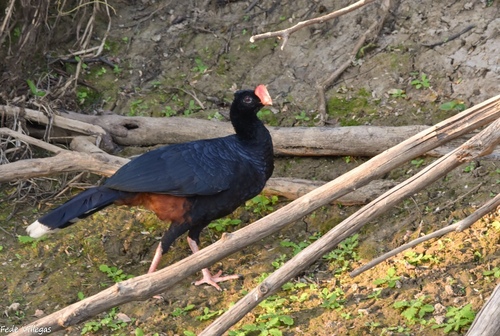
Razor-billed Curassow
Mitu tuberosum
With its striking red 'razor' bill and deep, resonant boom, the Razor-billed Curassow is a crown jewel of the South American rainforest. Discover how to capture this elusive ground-dweller on your trail camera.
Quick Identification
Size
Length: 83–89 cm (33–35 in); Weight: 2.5–3.8 kg (5.5–8.4 lbs)
Colors
Lustrous black plumage with a blue-purple sheen; crisp white belly and under-tail coverts; bright orange-red bill and legs.
Key Features
- Massive red bill with a high, flattened ridge (the 'razor')
- Glossy black feathers with blueish highlights
- Contrasting white belly and vent area
- Bright red-to-orange legs
- Large, turkey-sized silhouette
When You’ll See Them
Behavior
In social terms, these birds are typically observed in pairs or small family units. During the breeding season, males become quite vocal, emitting a deep, low-frequency booming call that can resonate through miles of dense vegetation. This 'song' is so low that it often feels more like a vibration in the air than a sound, used primarily to stake out territory and attract mates.
While they are shy around humans, they are remarkably curious about changes in their environment. They play a critical role in the ecosystem as seed dispersers; by consuming large quantities of forest fruit and moving across wide territories, they help maintain the incredible biodiversity of the Amazonian basin.
EverydayEarth exclusive
Camera Tips
In terms of lures, focus on natural attractants. If you have a fruiting tree on your property that is dropping its yield, this is your goldmine. These birds are highly sensitive to 'unnatural' scents and sounds; ensure your camera is well-camouflaged with local foliage and, if possible, use a model with 'No Glow' infrared flash. Standard LEDs can sometimes startle them, causing them to flush and leaving you with nothing but a blurry wing shot.
For settings, high-definition video is the way to go. The Razor-billed Curassow has a fascinating way of tilting its head and inspecting objects, which is much more engaging in video than in stills. Set your camera to record 20-second clips with a high sensitivity trigger. Since they are most active during the 'golden hours' of dawn and dusk, ensure your camera's exposure settings are optimized for low-light conditions to avoid grainy footage of that brilliant red bill.
Finally, patience is key. These birds have large home ranges and may only pass a specific spot once every few days. If you find a trail with large, three-toed footprints in the mud, leave your camera there for at least two weeks to catch their full rotation. During the dry season, a small, shallow water feature placed on the ground can be an irresistible draw for a curassow looking to hydrate.
Similar Species
Species that look similar or are commonly confused with Razor-billed Curassow.
Salvin's Curassow
Salvin's Curassow has a distinct white tip on its tail feathers, which is absent in the Razor-billed Curassow.
Crestless Curassow
Lacks the prominent 'razor' ridge on the bill and has a more uniform black appearance without the bright white belly.
Great Curassow
The Great Curassow has a curly crest of feathers on its head and a yellow knob on its bill, unlike the smooth head and red 'razor' bill of Mitu tuberosum.
Frequently Asked Questions
Record Razor-billed Curassow at your habitat
Connect a camera to start building your own species record — AI identifies every visitor automatically.