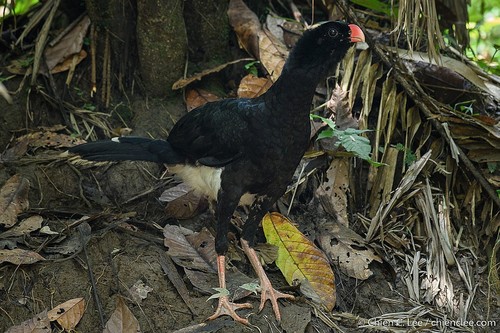
Salvin's Curassow
Birds diurnal

Salvin's Curassow

Mitu salvini

A ghost of the Amazonian understory, Salvin's Curassow is a magnificent, glossy-black bird known for its striking red bill and secretive nature. Spotting one on camera is a true mark of a successful trail cam setup in the tropics.

0 Sightings
0 Habitats

Quick Identification

straighten

Size

75–90 cm (30–35 inches) in length; weighs approximately 2–3 kg (4.4–6.6 lbs)

palette

Colors

Glossy blue-black plumage throughout most of the body; distinct white belly and undertail coverts; bright red or orange-red bill and legs.

visibility

Key Features

  • Large, turkey-sized bird with glossy black feathers
  • Bright white lower belly and undertail coverts
  • Deep red, slightly swollen bill without a prominent knob
  • Sturdy, reddish-orange legs

When You’ll See Them

schedule
Activity pattern diurnal
brightness_5
Peak hours 6:00 AM – 10:00 AM and 3:00 PM – 6:00 PM
calendar_month
Season Year-round, with increased vocal activity during the rainy season
restaurant
Diet Primarily frugivorous, focusing on fallen fruits and seeds on the forest floor; also consumes insects, small vertebrates, and occasional leaves.
park
Habitat Undisturbed lowland tropical rainforests, especially near riverbanks and seasonally flooded areas with thick undergrowth.

bar_chart
Loading activity data...

Behavior

Salvin's Curassows are primarily ground-dwelling birds that move with a regal, deliberate gait through the dense understory of tropical forests. While they spend much of their day foraging on the forest floor, they are agile fliers when startled, often retreating into the mid-canopy to seek safety. They are generally seen in pairs or small family groups, maintaining contact through low-frequency vocalizations that can carry long distances through the humid rainforest air.

These birds are notably shy and wary of human presence, which makes capturing them on a trail camera a significant achievement for any enthusiast. They play a vital role in their ecosystem as seed dispersers for various tropical trees. During the breeding season, males become more vocal, performing 'booming' displays early in the morning to establish territory and attract mates. Unlike many other curassow species, they do not have a prominent curly crest, giving them a smoother, sleeker head profile.

photo_camera EverydayEarth exclusive

Camera Tips

To capture the elusive Salvin's Curassow, placement is everything. These birds favor established 'game trails' or old logging paths near permanent water sources within dense forest. Position your camera about 18 to 24 inches off the ground to capture their full profile and the distinct white belly markings that identify the species. Aim the camera at a slight downward angle toward a clearing or a spot where fruit-bearing trees, like wild figs or palms, are dropping their bounty, as these are natural magnets for the species.

Because they are highly sensitive to movement and unnatural lights, use a 'No-Glow' or black infrared flash to avoid spooking them during the dim light of dawn and dusk when they are most active. Set your camera to a 'Burst' or 'Rapid-Fire' mode with 3-5 photos per trigger. This is crucial because curassows move slowly and often stop to listen; a single photo might miss the perfect head-up posture or the moment they display their bill.

If your camera supports high-definition video, a 15-20 second clip is highly recommended. This can capture their unique 'pumping' tail movement and low-frequency booming calls which are rarely heard clearly in the wild. While traditional backyard bird feeders won't work for this deep-forest species, you can simulate a natural foraging site if you live in their range. If legal and ethical in your area, placing a small pile of local fallen fruits in a secluded, shaded spot can entice them to linger in front of the lens.

Be patient; these birds have large home ranges and may only pass a specific spot every few days. Check your batteries and SD cards frequently, as the humid Amazonian environment can be tough on equipment. Consider using a desiccant pack inside the camera housing to prevent lens fogging, which is a common issue when monitoring ground-dwelling birds in high-humidity habitats.

Frequently Asked Questions

Salvin's Curassows are strictly diurnal, meaning they are active during daylight hours. You are most likely to capture them on camera during the early morning hours just after sunrise and again in the late afternoon before they retreat to high branches to roost for the night.
These are deep-forest birds, so they are rarely found in traditional suburban backyards unless you live adjacent to primary tropical rainforest. To attract them to a camera site, focus on areas with fallen wild fruits like figs or palm nuts, which are their favorite natural snacks.
Their diet is mostly vegetarian, consisting of various fallen fruits and seeds found on the forest floor. However, they are opportunistic and will supplement their diet with insects, snails, and even small lizards if the opportunity arises.
No, Salvin's Curassows are highly sensitive to habitat fragmentation and human disturbance. They are restricted to relatively undisturbed lowland forests in Colombia, Ecuador, and Peru, making them a 'wild' species rather than a suburban one.
The most reliable way to distinguish Salvin's Curassow is by its white belly and undertail coverts. The closely related Razor-billed Curassow has a chestnut-brown (rufous) belly. Additionally, Salvin's Curassow lacks the highly arched 'helmet' on its bill seen in some other species.

Record Salvin's Curassow at your habitat

Connect a camera to start building your own species record — AI identifies every visitor automatically.

Join free Identify a photo