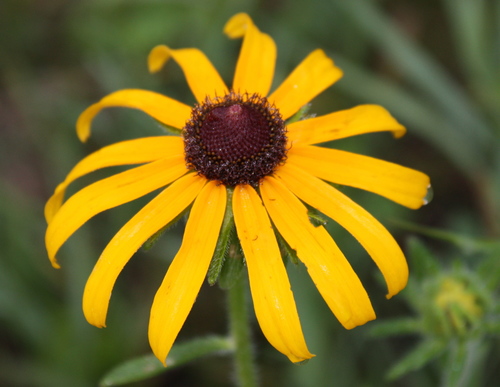
black-eyed Susan
Rudbeckia hirta
A golden icon of the American landscape, the black-eyed Susan is a hardy wildflower that serves as a vital oasis for pollinators. Its sun-tracking blooms and winter seed heads make it a year-round focal point for backyard wildlife enthusiasts.
Quick Identification
Size
Height: 30–100 cm (1–3.3 ft); Flower heads: 5–8 cm (2–3 in) wide
Colors
Bright golden-yellow petals with a dark chocolate-brown to black central disk; stems and leaves are dull green
Key Features
- Daisy-like yellow flower heads with dark conical centers
- Coarse, bristly hairs covering stems and leaves
- Alternate, lance-shaped leaves with slightly toothed margins
- Tall, upright growth habit often found in clusters
When You’ll See Them
Geographic range
Where Does the black-eyed Susan Live?
Native to the vast heartland of North America, the black-eyed Susan is one of the continent's most recognizable wildflowers. Its core range spans from the Rocky Mountains through the Great Plains to the Atlantic coast, covering nearly all of the contiguous United States and southern Canada. While it originated in the central prairies, it has successfully naturalized across Europe and parts of Asia due to its popularity in gardening and its ability to adapt to various temperate climates.
Basemap © OpenStreetMap contributors
Behavior
Black-eyed Susans are resilient pioneer species, often among the first to colonize areas after a fire or soil disturbance. They exhibit a fascinating heliotropic behavior, where the flower heads subtly track the sun across the sky during the day to maximize the warmth on their central disks, which in turn attracts more pollinators. While they are often biennials or short-lived perennials, they are prolific self-seeders, allowing a single planting to persist for decades in a backyard setting.
These plants act as a social hub in the wild. Throughout the mid-summer blooming period, they provide a consistent landing platform for dozens of insect species. They have evolved a symbiotic relationship with local wildlife; while their bitter-tasting leaves deter many mammalian herbivores like deer, their nectar is highly accessible, making them a preferred stop for everything from tiny sweat bees to large swallowtail butterflies.
EverydayEarth exclusive
Camera Tips
Capturing the black-eyed Susan on an AI wildlife camera is less about the plant itself and more about the 'pollinator party' it hosts. To get the best footage, place your camera on a ground stake or short tripod, positioning the lens roughly 12 to 18 inches from the ground. Angle the camera slightly upward toward the flower heads. This perspective allows you to see the underside of the petals and the intricate details of the insects as they land on the dark central cone.
Sunlight is your best friend and worst enemy. Because these flowers thrive in full sun, place your camera facing North or South to avoid the harsh glare of the morning or evening sun directly into the lens. The peak activity for pollinators like bees and butterflies occurs between 10 AM and 2 PM on warm, still days. If your camera has a high-speed trigger or a dedicated 'macro' focus mode, these are ideal for freezing the rapid wing movements of visiting clearwing moths or hoverflies.
Don't pack the camera away when the petals fall in late autumn. One of the best times for bird photography is during the winter months when the flower heads have dried and turned into seed-filled 'cones.' Leave the camera active to catch American Goldfinches, Chickadees, and Nuthatches perched precariously on the stems while they pry out the tiny seeds. A time-lapse setting can also be used during the spring to document the rapid growth of the stalks from the basal rosette.
Similar Species
Species that look similar or are commonly confused with black-eyed Susan.
Frequently Asked Questions
Record black-eyed Susan at your habitat
Connect a camera to start building your own species record — AI identifies every visitor automatically.