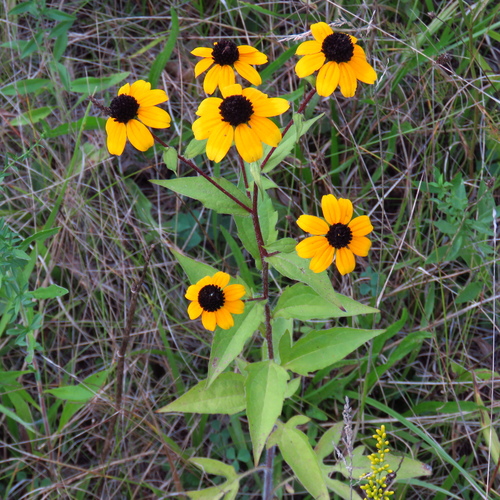
brown-eyed Susan
Rudbeckia triloba
The brown-eyed Susan is a late-summer star, offering a prolific display of golden blooms that serve as a vital nectar bar for pollinators. Its unique three-lobed leaves and dark button centers make it a standout favorite for both gardeners and backyard wildlife photographers.
Quick Identification
Size
60–150 cm (24–60 inches) tall; flower heads 2.5–4 cm (1–1.5 inches) in diameter
Colors
Golden-yellow ray flowers (petals) and dark brownish-purple central disks; deep green foliage
Key Features
- Dark, button-like central disk without petals in the very center
- Distinctive three-lobed lower leaves
- Highly branched stems producing a massive display of small flowers
- Hairy stems and thin, lance-shaped upper leaves
When You’ll See Them
Geographic range
Where Does the brown-eyed Susan Live?
The brown-eyed Susan is a quintessential North American wildflower, native primarily to the central and eastern United States. Its natural footprint stretches from the Great Plains eastward to the Atlantic coast, and from the Great Lakes down to the Gulf States. While it thrives in its core Midwestern range, it has successfully naturalized in parts of Canada and is widely cultivated in temperate gardens across the globe due to its hardy nature.
Basemap © OpenStreetMap contributors
Behavior
Unlike many garden flowers that bloom early and fade, the brown-eyed Susan is a late-season powerhouse. It typically functions as a short-lived perennial or biennial, spending its first year growing foliage and its second year erupting into a cloud of golden blossoms. Because it is highly branched, a single plant can produce hundreds of small flower heads simultaneously, creating a dense 'shrub-like' appearance that provides excellent cover for small ground-dwelling creatures.
In the backyard ecosystem, this plant acts as a social hub. During the daylight hours, it is a primary nectar source for various native bees, wasps, and butterflies. As the season progresses into autumn, the behavior of the plant shifts from pollinator magnet to bird feeder. The central cones harden and fill with oil-rich seeds that remain available even after the first frosts, making the plant a vital resource for resident birds preparing for winter.
EverydayEarth exclusive
Camera Tips
Capturing the brown-eyed Susan on a backyard camera is less about the plant itself and more about the incredible diversity of wildlife it attracts. To get the best results, mount your camera on a short stake or tripod at 'flower height'—typically 3 to 4 feet off the ground. Position the camera about 2 to 3 feet away from a dense cluster of blooms. This proximity allows for high-detail triggers when butterflies or bees land, which are the primary visitors during the peak summer months.
Because the flowers sway easily in the breeze, avoid using standard motion-trigger settings if you want to save battery; instead, use a 'Time Lapse' mode during the brightest parts of the day (10 AM to 3 PM) to capture the cycle of pollinator visits. If your camera has a macro lens or a close-focus feature, this is the perfect species to test it on. The intricate geometry of the dark central disk provides a stunning focal point for high-resolution images.
Don't pack the camera away once the petals fall. In late September and October, keep your camera focused on the dried seed heads. This is the best time to capture rare shots of American Goldfinches, Chickadees, and Nuthatches clinging to the stems to feast on the seeds. For these shots, a faster shutter speed is essential to freeze the rapid movement of the birds' wings. Aim your camera facing North or South to avoid the harsh direct glare of the low autumn sun, which can wash out the golden tones of the fading stems.
Similar Species
Species that look similar or are commonly confused with brown-eyed Susan.
Frequently Asked Questions
Record brown-eyed Susan at your habitat
Connect a camera to start building your own species record — AI identifies every visitor automatically.