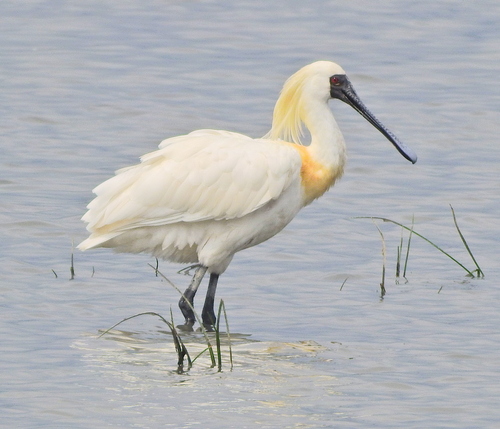
Black-faced Spoonbill
Platalea minor
The rarest of all spoonbills, this elegant 'Plate-bill' is a symbol of conservation success in East Asia. With its distinctive mask and rhythmic sweeping dance, it is a crown jewel for any coastal wildlife observer.
Quick Identification
Size
Length: 74–76 cm (29–30 in); Wingspan: approx 110 cm (43 in); Weight: 1.5–2 kg (3.3–4.4 lbs)
Colors
Pure white plumage; black facial skin and bill; breeding adults develop golden-yellow feathers on the breast and a yellow bushy crest.
Key Features
- Distinctive black, spatula-shaped bill
- Black facial 'mask' extending behind the eye
- Long black legs and unfeathered lower thighs
- Sweeping side-to-side feeding motion
When You’ll See Them
Geographic range
Where Does the Black-faced Spoonbill Live?
Native exclusively to the eastern coast of Asia, the Black-faced Spoonbill has one of the most restricted ranges of any waterbird. It breeds on a handful of small, rocky islands off the western coast of North and South Korea and the Chinese province of Liaoning. During the winter, the population migrates south to core wintering sites in Taiwan, Hong Kong, Macau, Vietnam, and southern Japan, making it a true icon of the East Asian-Australasian Flyway.
Basemap © OpenStreetMap contributors
Behavior
The Black-faced Spoonbill is a highly social bird, often found in small groups or occasionally in larger flocks of up to 50 individuals. They are famously tactile feeders; rather than hunting by sight like a heron, they submerge their sensitive, partially open bills into shallow water and sweep them from side to side in a rhythmic arc. When the bill touches a fish or shrimp, it snaps shut with incredible speed.
These birds are generally quiet and shy, preferring to roost in groups during the day to stay alert for predators. They are deeply affected by human disturbance, particularly in their coastal wintering grounds. Their daily rhythm is dictated more by the tides than the sun, as they move between roosting sites and foraging mudflats as the water levels change.
EverydayEarth exclusive
Camera Tips
To capture the Black-faced Spoonbill, your camera placement is everything. Since these birds are coastal specialists, you should position your camera along the edges of mudflats or salt pans where the water is no more than 10–15 cm deep. A low-angle mount is essential; placing the camera just inches above the high-tide mark provides an intimate, 'eye-level' perspective that highlights the unique texture of their spatulate bills.
Because these birds are sensitive to movement, a stationary trail camera is often more effective than a handheld setup. Use a wide-angle lens if possible, as they often forage in groups, and you’ll want to capture the social dynamics of the flock. Avoid using bright white flashes at night; instead, rely on high-quality infrared (no-glow) sensors to avoid spooking the birds during their nocturnal feeding sessions. Set your trigger speed to the fastest possible setting to catch the rapid 'snap' of the bill during a successful hunt.
Timing is more important than time of day. Check local tide tables and set your camera to be most active during the transition periods between high and low tide. This is when the water depth is perfect for their sweeping feeding technique. In the winter months, look for 'roosting piles' where they huddle together to conserve heat—this can provide stunning group shots, though you must ensure the camera is placed far enough away to avoid causing the flock to take flight.
Similar Species
Species that look similar or are commonly confused with Black-faced Spoonbill.
Frequently Asked Questions
Record Black-faced Spoonbill at your habitat
Connect a camera to start building your own species record — AI identifies every visitor automatically.