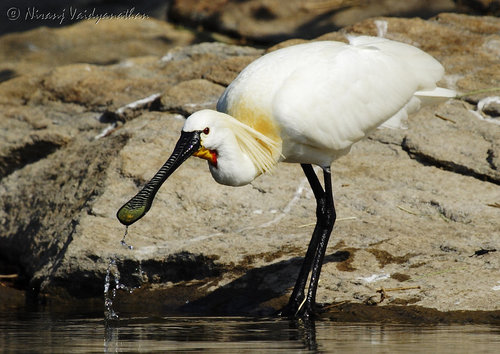
Eurasian Spoonbill
Platalea leucorodia
With its iconic spatula-shaped bill and elegant white plumage, the Eurasian Spoonbill is one of the most distinctive wading birds in the Old World. Once rare, this social bird is making a triumphant comeback in wetlands across Europe and Asia.
Quick Identification
Size
Length: 80–90 cm (31–35 in); Wingspan: 120–150 cm (47–59 in); Weight: 1.2–2 kg (2.6–4.4 lbs)
Colors
Almost entirely white plumage. Adults have black legs and a black bill with a distinctive yellow tip. During the breeding season, they develop a yellow patch on the breast and a small crest of feathers on the back of the head.
Key Features
- Broad, spatulate bill that is flattened at the end
- Long, slender black legs and neck
- White body with a yellow-tinged chest patch in breeding adults
- Distinctive 'side-to-side' sweeping motion while foraging in water
When You’ll See Them
Geographic range
Where Does the Eurasian Spoonbill Live?
The Eurasian Spoonbill is a wide-ranging species native to the vast wetlands of Europe, Asia, and Africa. Its breeding range extends from the Atlantic coasts of the Netherlands and Spain across Central and Southern Europe, reaching into Central Asia, India, and China. In the winter months, northern populations migrate to the warmer climates of Sub-Saharan Africa and South Asia, while residents can be found throughout the Mediterranean basin. Due to successful conservation efforts, they are also re-establishing strong breeding populations in the United Kingdom and northern France.
Basemap © OpenStreetMap contributors
Behavior
The Eurasian Spoonbill is a highly gregarious species, often found in small groups or large colonies known as heronries. They are social breeders, frequently nesting alongside other wading birds like herons and egrets. Their most famous behavior is their unique foraging technique: they walk through shallow water with their bill slightly open, swinging it in a wide arc from side to side to feel for prey. When a small fish or insect touches the sensitive bill, it snaps shut instantly.
While generally shy of human interaction, they have become increasingly visible in restored wetlands and coastal reserves across Europe. They are partially migratory; birds from the northern reaches of their range, such as the Netherlands and the UK, often fly south to Africa or southern Europe for the winter, while populations in warmer climates may remain resident year-round. They communicate through low grunts and bill-clattering, especially during the nesting season.
EverydayEarth exclusive
Camera Tips
Capturing the Eurasian Spoonbill on camera requires a focus on shallow water margins. Position your camera at a very low angle, approximately 30-50 cm (12-20 in) above the water level, near the edges of mudflats or reed beds. This low perspective highlights the unique spoon-shaped bill and the dramatic sweeping motion they use while feeding. If you are near a known foraging pool, aim the camera toward the sun-dappled areas where they are likely to sift for fish during the early morning hours.
Since these birds are sensitive to movement, a fixed trail camera with a fast trigger speed is essential. Use a high shutter speed setting if your camera allows it, as their 'sweeping' feeding action is surprisingly fast and can result in motion blur in lower light. In coastal areas, timing is everything—set your camera to record during the two hours before and after high tide, as this is when the birds are pushed closer to the shore and into the range of your lens.
While baiting is not recommended for this species, you can increase your chances by looking for 'pinch points' in a marsh—narrow channels of water that connect larger pools. Spoonbills will often walk through these narrow sections, giving you a predictable path for camera placement. During the breeding season (late spring), look for areas with tall reeds or low-hanging trees over water, as these are preferred roosting and nesting sites. A camera with a good telephoto reach or a high-resolution sensor for cropping will help you get clear shots without disturbing their delicate nesting environment.
Similar Species
Species that look similar or are commonly confused with Eurasian Spoonbill.
Great Egret
Has a sharp, pointed yellow bill and flies with its neck tucked in, unlike the Spoonbill's flat bill and extended neck.
African Spoonbill
Distinguished by its red face and legs, whereas the Eurasian Spoonbill has a black face and black legs.
Little Egret
Much smaller with a thin black bill and yellow feet; lacks the spatulate bill shape entirely.
Frequently Asked Questions
Record Eurasian Spoonbill at your habitat
Connect a camera to start building your own species record — AI identifies every visitor automatically.