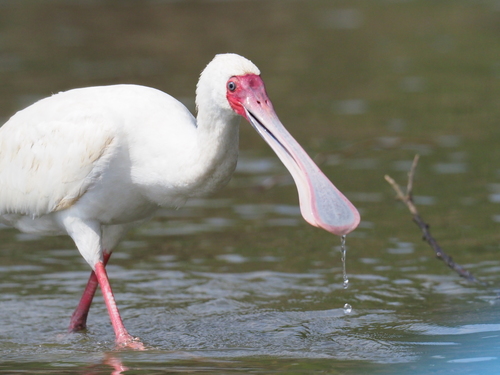
African Spoonbill
Platalea alba
With its iconic spoon-shaped bill and striking red legs, the African Spoonbill is a master of the shallows. This elegant white wader brings a touch of prehistoric grace to wetlands across the African continent.
Quick Identification
Size
75–91 cm (30–36 in) long; wingspan of 120–135 cm (47–53 in); weight 1.4–1.9 kg (3.1–4.2 lbs)
Colors
Brilliant white plumage; bare red facial skin; blue-grey to silver bill with reddish margins; bright red legs and feet
Key Features
- Distinctive flat, spoon-shaped bill
- Bare red face and forehead
- Bright red legs and feet
- Pure white feathers without a crest
When You’ll See Them
Sightings on EverydayEarth
Jul 30, 2026
A Common Hippopotamus rests submerged in a pool, with its head and ears clearly visible above the waterline. In the foreground, an African Spoonbill stands resting on a large boulder to the left, while a Grey Heron stands perched on the rocks to the right, surveying the water.
Jul 30, 2026
A bustling morning scene at a waterhole features multiple hippos lounging in the water, with one large individual walking along the right bank into the river. On the far grassy bank, a common warthog trots from right to left. Several water birds are present, including an African spoonbill on a log, and a black-headed heron and marabou stork standing on foreground rocks.
Jul 29, 2026
An African Spoonbill stands atop a large rock in the middle of a flowing river. The bird keeps its bill tucked into its feathers while resting, occasionally shifting its weight as the wind ruffles its plumage.
Geographic range
Where Does the African Spoonbill Live?
The African Spoonbill is a hallmark species of the African continent, ranging extensively across Sub-Saharan Africa and the island of Madagascar. They are commonly spotted from the wetlands of Kenya and Ethiopia down through the floodplains of Botswana and Zimbabwe into the coastal regions of South Africa. While they are mostly resident, they can be nomadic, moving long distances to find fresh water sources during periods of drought.
Basemap © OpenStreetMap contributors
Behavior
The African Spoonbill is a highly social and gregarious bird, usually found in small groups but known to congregate in large colonies during the breeding season. They are primarily diurnal, spending their days wading through shallow water with a characteristic side-to-side 'scything' motion. This unique movement allows them to use their highly sensitive bills to detect prey through touch rather than sight, making them efficient hunters even in murky or silt-heavy waters.
While they are generally shy and will take flight if approached too closely, they are quite comfortable in suburban environments that offer quiet water features. They often roost in trees or reed beds at night to stay safe from terrestrial predators. They are relatively quiet birds, though they may emit occasional grunts or clatter their bills during social interactions or at the nest site.
EverydayEarth exclusive
Camera Tips
To capture high-quality footage of an African Spoonbill, camera placement is critical. These birds are exclusively water-edge foragers, so position your camera on a low-profile mount or stake roughly 12 to 18 inches above the ground at the very edge of a pond or marsh. Point the camera toward shallow 'shelves' where the water is no more than 6 inches deep, as this is where they perform their iconic side-to-side feeding sweeps. An eye-level perspective will yield much more professional results than a high-downward angle.
Because the African Spoonbill is a brilliant, pure white, exposure settings are your biggest hurdle. In bright midday sun, their feathers often 'blow out' and lose all detail. Set your camera to underexpose slightly if possible, or prioritize early morning and late afternoon sessions when the light is softer. Using a camera with a high frame rate or fast trigger speed is also helpful, as their head-swinging motion can be quite rapid and prone to motion blur in low-light conditions.
While you cannot easily bait a spoonbill with food, you can attract them by maintaining a quiet, shallow water area free of heavy human or dog traffic. They are sensitive to movement, so ensure your camera is well-camouflaged or hidden behind reeds. If you are using an AI-powered camera, ensure the detection zone is focused on the water's surface rather than the background to avoid missing the quick 'dip' of the bill as they feed.
Similar Species
Species that look similar or are commonly confused with African Spoonbill.
Eurasian Spoonbill
Features a black bill with a yellow tip and black legs, whereas the African species has a blue-grey bill and red legs.
Yellow-billed Spoonbill
Native to Australia; has a distinct yellow bill and yellow legs compared to the red features of the African Spoonbill.
Great Egret
Similar white plumage and size, but has a sharp, pointed yellow bill and black legs, and lacks the spoon-shaped bill.
Frequently Asked Questions
Record African Spoonbill at your habitat
Connect a camera to start building your own species record — AI identifies every visitor automatically.