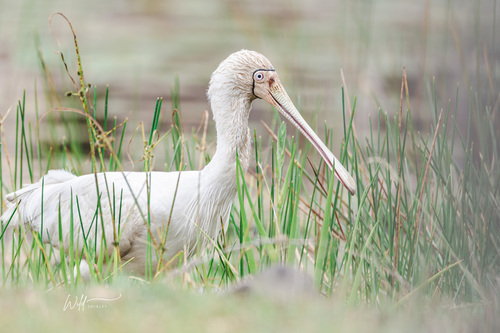
Yellow-billed Spoonbill
Platalea flavipes
Meet the elegant architect of the Australian wetlands, famous for its golden spoon-shaped bill and rhythmic feeding dance. A frequent visitor to freshwater shallows, this stunning white bird is a favorite for backyard observers and trail-cam enthusiasts alike.
Quick Identification
Size
Length: 76–91 cm (30–36 in); Wingspan: 120–135 cm (47–53 in); Weight: 1.7–2.5 kg (3.7–5.5 lbs)
Colors
Uniformly pure white plumage; distinctive yellow bill, legs, and feet; pale yellow facial skin often bordered by a thin black line.
Key Features
- Large spatulate yellow bill
- Long yellow stilt-like legs
- Pure white feathers with no dark markings
- Facial skin is pale yellow with a blue-grey ring around the eye
When You’ll See Them
Behavior
The Yellow-billed Spoonbill is a patient and methodical hunter, easily recognized by its distinctive side-to-side sweeping motion as it forages in shallow water. Unlike many other wading birds that hunt by sight, the spoonbill relies on the sensitive tactile nerves inside its bill to 'feel' prey in murky water. It is a gregarious species, often found in small flocks or alongside other waterbirds like ibises, herons, and its close relative, the Royal Spoonbill.
While they are primarily aquatic, these birds are strong flyers and often commute between different wetlands or roosting sites in the canopy of tall trees near water. They are generally peaceful and quiet, though they may emit low grunts during the breeding season. In suburban environments with healthy waterways, they can become quite accustomed to a human presence, provided they are given enough space to forage undisturbed.
EverydayEarth exclusive
Camera Tips
To capture the best footage of a Yellow-billed Spoonbill, focus your camera on the 'wade zone'—the area where water is roughly 10 to 20 centimeters deep. Position the camera on a tripod or mount it to a post at a height of about 2 feet (60 cm) from the ground, angling it slightly downward to catch the bird's unique bill-sweeping behavior. Because these birds are quite tall, a wide-angle lens or a generous distance of 10-15 feet from the target area is recommended to ensure you don't cut off their heads or legs when they stand upright.
Lighting is your biggest challenge with this species. Their bright white feathers reflect a tremendous amount of light, which can cause 'white-out' on many digital sensors during the middle of the day. For the most stunning results, configure your camera to be most active during the 'golden hours' of dawn and dusk. If your camera software allows for manual exposure compensation, setting it to -0.5 or -1.0 will help preserve the intricate texture of the feathers rather than letting them bloom into a solid white shape.
If you are placing a camera in a backyard near a pond, look for a 'loafing spot.' These are usually flat rocks, logs, or low branches overhanging the water where spoonbills like to preen and rest after feeding. These spots offer excellent opportunities for behavior-rich photos. While you shouldn't use food lures, ensuring your pond has plenty of natural vegetation will attract the aquatic insects they eat. Use a high-speed trigger setting or a multi-shot burst mode, as the bill-snapping action is lightning fast and easy to miss with a single-frame capture.
Similar Species
Species that look similar or are commonly confused with Yellow-billed Spoonbill.
Frequently Asked Questions
Record Yellow-billed Spoonbill at your habitat
Connect a camera to start building your own species record — AI identifies every visitor automatically.