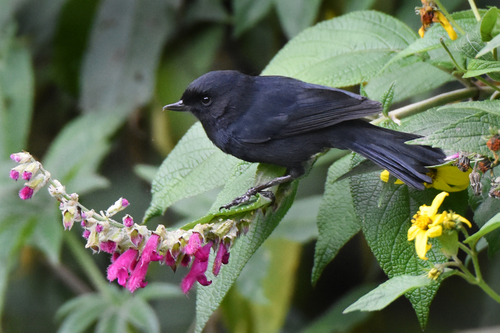
Black Flowerpiercer
Diglossa humeralis
A sleek, obsidian-colored specialist of the high Andes, the Black Flowerpiercer is nature’s clever nectar thief. Distinguished by its unique hooked bill, this small bird is a fascinating and bold addition to any high-altitude backyard.
Quick Identification
Size
Length of 13-14 cm (5.1-5.5 in); weight approximately 12-15 grams (0.4-0.5 oz)
Colors
Uniformly velvety black plumage; small bluish-grey or slate-grey shoulder patches (less prominent in some subspecies); dark iris and black bill.
Key Features
- Upturned bill with a sharp hooked tip
- Solid black plumage with subtle grey shoulder patches
- Small, energetic build
- Frequently seen 'robbing' nectar from the base of flowers
When You’ll See Them
Geographic range
Where Does the Black Flowerpiercer Live?
Native to the South American continent, the Black Flowerpiercer is a specialist of the Andean mountain chain. Its core range extends through the highlands of Venezuela, Colombia, Ecuador, and northern Peru. These birds are primarily found in moist montane environments and high-elevation gardens, often thriving in urban centers like Bogotá and Quito due to their adaptability to ornamental flowers.
Basemap © OpenStreetMap contributors
Behavior
The Black Flowerpiercer is a highly active and territorial inhabitant of high-altitude gardens and forest edges. Unlike hummingbirds that reach deep into the flower’s tube, the flowerpiercer is a 'nectar robber.' Using its uniquely adapted hooked upper mandible to steady the flower, it uses its sharp lower mandible to pierce the base of the corolla, extracting nectar without providing any pollination services to the plant.
These birds are generally solitary and can be surprisingly aggressive, often chasing away other nectar feeders from their favorite feeding patches. In backyard settings, they are bold and adaptable, frequently visiting hummingbird feeders or flowering hedges even in close proximity to human activity.
EverydayEarth exclusive
Camera Tips
To capture the Black Flowerpiercer on camera, position your device near tubular flowers like Fuchsia, Salvia, or Abutilon. Since these birds are nectar robbers, they don't hover like hummingbirds; they perch on the stem and lean down to pierce the bloom. Aim your camera at a cluster of flowers where a sturdy branch or stem provides a convenient perch for the bird to land on.
If you use a hummingbird feeder, place your camera at eye level with the feeder ports. Flowerpiercers are notorious for drinking from the side of the port or even the gaps in the feeder lid. A high-speed shutter or 'burst mode' is essential, as these birds move with quick, jerky motions. Because they are solid black, avoid placing the camera in direct, harsh midday sun, which can wash out their subtle grey shoulder patches; early morning or slightly overcast light provides the best contrast for their plumage.
Since they are resident birds, consistency is key. Keep your feeders clean and your garden watered to ensure a steady supply of blooms. If your camera has a 'motion zones' feature, focus the trigger area specifically on the flowers or the feeder perches to avoid false triggers from wind-blown leaves.
Similar Species
Species that look similar or are commonly confused with Black Flowerpiercer.
Frequently Asked Questions
Record Black Flowerpiercer at your habitat
Connect a camera to start building your own species record — AI identifies every visitor automatically.