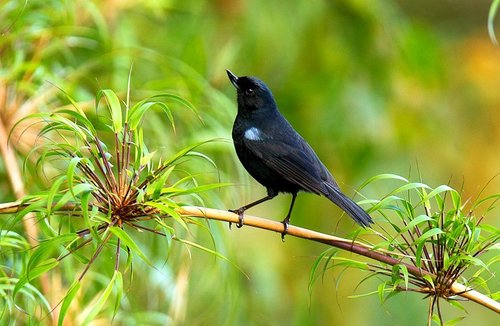
Glossy Flowerpiercer
Diglossa lafresnayii
The Glossy Flowerpiercer is the clever 'nectar thief' of the Andes, easily recognized by its uniquely hooked bill and shimmering obsidian feathers. A bold visitor to high-altitude gardens, this energetic bird brings a touch of mountain mystery to any backyard camera.
Quick Identification
Size
14.5–15.5 cm (5.7–6.1 in) in length; weight ranges from 14–20 grams (0.5–0.7 oz)
Colors
Uniformly glossy blue-black plumage with small white tufts at the shoulder (often hidden); iris is typically dark red or maroon
Key Features
- Distinctive hooked upper mandible and upturned lower mandible
- Deep glossy black feathers with a subtle blue sheen
- Small white 'pectoral tufts' visible at the bend of the wing
- Stocky, short-tailed silhouette compared to other tanagers
When You’ll See Them
Geographic range
Where Does the Glossy Flowerpiercer Live?
The Glossy Flowerpiercer is native to the majestic mountain ranges of South America. It is a permanent resident of the Andes, spanning from western Venezuela through Colombia and Ecuador into northern Peru. These birds are high-altitude specialists, thriving in the misty, cool environments of the upper montane zones where they are frequently spotted by birdwatchers and backyard observers alike.
Basemap © OpenStreetMap contributors
Behavior
The Glossy Flowerpiercer is a high-altitude specialist famous for its 'nectar robbing' behavior. Unlike hummingbirds that reach into the front of a flower, this bird uses its specialized hooked bill to pierce the base of a flower's corolla to extract nectar. This allows it to feed on a wide variety of flowers that it wouldn't otherwise be able to pollinate, making it a common sight in Andean gardens and cloud forests.
These birds are notably territorial and energetic. They are frequently seen flitting restlessly between shrubs or chasing away other flowerpiercers and hummingbirds from their preferred feeding patches. While they are usually solitary or found in pairs, they occasionally join mixed-species foraging flocks moving through the sub-alpine scrub. They are relatively bold and have adapted well to human-modified landscapes where flowering plants are abundant.
EverydayEarth exclusive
Camera Tips
To capture the Glossy Flowerpiercer on your backyard or trail camera, focus on 'bottleneck' locations where flowering plants are dense. Since these birds follow specific feeding routes, placing a camera near tubular blossoms like Salvia, Fuchsia, or Cavendishia is highly effective. Set your camera 3 to 5 feet away from the flowers and aim for a slightly upward angle to capture the unique hook on their bill as they work the base of the blooms.
Lighting is the biggest challenge with this species; their dark, glossy feathers can easily appear as a featureless black shape. Try to position your camera so the morning sun hits the feeding area directly; this will reveal the beautiful blue sheen in their plumage and the detail of their red eyes. If your camera allows for sensitivity adjustments, set it to a high trigger speed, as these birds are fast-moving and rarely stay still for more than a few seconds.
While they are primarily nectar thieves, they are also attracted to hummingbird feeders. Mounting a camera at eye level with a feeder and using a macro or close-focus lens setting can provide stunning portraits. Ensure the background is somewhat distant or light-colored to provide contrast against the bird's dark body, which helps the AI detection software lock onto the subject more accurately.
Similar Species
Species that look similar or are commonly confused with Glossy Flowerpiercer.
Frequently Asked Questions
Record Glossy Flowerpiercer at your habitat
Connect a camera to start building your own species record — AI identifies every visitor automatically.