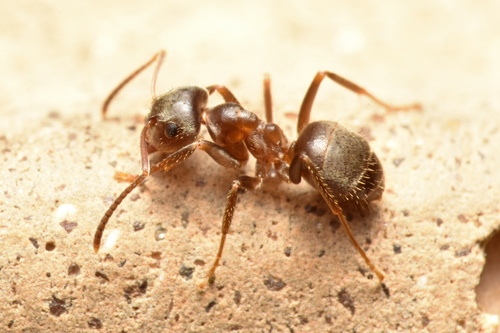
Black Garden Ant
Lasius niger
The ultimate backyard socialite, the Black Garden Ant is a master engineer and shepherd that builds vast underground empires beneath our feet.
Quick Identification
Size
Workers: 3-5 mm (0.12-0.20 in); Queens: up to 9 mm (0.35 in)
Colors
Glossy brownish-black to deep black body with fine silver-grey hairs visible under magnification
Key Features
- Single-segmented waist (petiole) node
- Uniformly dark, glossy black or dark brown body
- Twelve-segmented antennae with a long first segment
- Fast-moving and highly active foragers
When You’ll See Them
Geographic range
Where Does the Black Garden Ant Live?
Originally native to the temperate regions across Europe and Asia, the Black Garden Ant is one of the most widely distributed ant species in the northern hemisphere. While it is a staple of British and European backyards, it has also established significant populations in North America and parts of the Southern Hemisphere through accidental introduction. These ants thrive in human-altered landscapes, making them the most common ant species encountered in urban and suburban environments.
Basemap © OpenStreetMap contributors
Behavior
The Black Garden Ant is a highly social and industrious insect, living in complex underground colonies that can house up to 15,000 workers, though average colonies are smaller. They are famous for their symbiotic relationship with aphids, which they 'farm' for honeydew. The ants protect the aphids from predators and even carry them to fresh plants, effectively acting as tiny shepherds in exchange for a reliable sugar source.
These ants are generally non-aggressive toward humans, though they are fiercely territorial against other ant colonies. Their behavior is governed by sophisticated chemical communication using pheromone trails to lead nestmates to food sources. One of their most notable social events is the annual 'nuptial flight,' occurring on warm, humid summer days when thousands of winged queens and males take to the air simultaneously to mate and establish new colonies.
EverydayEarth exclusive
Camera Tips
To capture high-quality footage of Black Garden Ants, you need to think small. Standard trail cameras often have a minimum focus distance that is too long for these tiny insects, so using a camera with a macro lens or a 'close-up' focus mode is essential. Look for high-traffic 'ant highways'—usually visible as thin lines along the edges of garden paths, patio bricks, or running vertically up the bark of fruit trees where they might be tending to aphids.
Baiting is the secret to getting a clear shot. Place a small bottle cap filled with a sugar-water solution or a dab of jam in front of the camera lens. This will cause the ants to pause and cluster in one spot, allowing your camera to capture their intricate movements and social interactions. For a more natural look, use a piece of overripe fruit like a bruised peach or strawberry, which will attract workers within minutes during the summer months.
Lighting is a major challenge due to their dark, reflective carapaces. To avoid losing detail in a mass of black, try to position your camera in a spot with soft, filtered sunlight. Early morning or late afternoon light provides the best contrast. If your camera is at ground level, try to angle it slightly upward or horizontally across the ground to get an 'ant's-eye view,' which looks much more dramatic and professional than a top-down shot. During the late summer nuptial flights, keep your camera ready near nest entrances to capture the spectacular sight of winged queens emerging.
Similar Species
Species that look similar or are commonly confused with Black Garden Ant.
Frequently Asked Questions
Record Black Garden Ant at your habitat
Connect a camera to start building your own species record — AI identifies every visitor automatically.