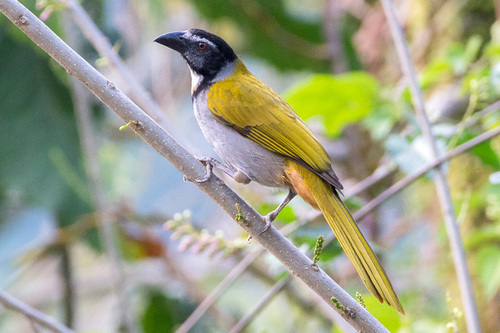
Black-headed Saltator
Saltator atriceps
A bold, noisy, and strikingly masked songbird, the Black-headed Saltator is a master of the Central American forest edges. With its tuxedo-like throat and heavy bill, it's a favorite for backyard birders from Mexico to Panama.
Quick Identification
Size
21–25 cm (8.3–9.8 in) in length; weight ranges from 61–105 g (2.1–3.7 oz)
Colors
Dull olive-green upperparts, grey underparts, and a distinctive jet-black head. Features a white throat patch bordered by a black line, and a heavy bill that is black with a yellowish or pale tip.
Key Features
- Jet-black head and face mask
- White throat patch encircled by a black 'necklace'
- Heavy, seed-cracking bill with a pale tip
- Olive-green back and wings contrasting with a grey belly
When You’ll See Them
Geographic range
Where Does the Black-headed Saltator Live?
Native to the lush regions of North and Central America, the Black-headed Saltator is a staple of the tropical landscape. Its core range extends from the humid lowlands of central Mexico, sweeping through the entirety of Central America including Belize, Guatemala, and Costa Rica, before reaching its southern limit in eastern Panama. In these regions, it is a permanent resident, favoring the edges of rainforests and verdant suburban gardens over deep, primary forest interiors.
Basemap © OpenStreetMap contributors
Behavior
The Black-headed Saltator is a boisterous and highly social bird, often heard before it is seen. Known for its loud, scratchy, and somewhat discordant song, it moves through the canopy and garden edges in pairs or small family groups. Unlike many shy forest birds, this species is relatively bold and well-adapted to human-altered landscapes, frequently visiting suburban gardens and fruit plantations.
In the wild, they are active foragers that move with a deliberate, jerky motion through dense foliage. They are not particularly territorial outside of the breeding season and can often be found in 'mixed-species flocks,' traveling alongside other tanagers and flycatchers. While they are primarily arboreal, they will occasionally descend to lower shrubs to investigate a new food source or a water feature.
EverydayEarth exclusive
Camera Tips
To capture the Black-headed Saltator on camera, positioning is everything. These birds are 'edge' specialists, meaning they love the transition zone between dense forest and open clearings. Mount your camera between 5 and 8 feet high on a tree overlooking a garden edge or a clearing with fruiting shrubs. Since they are highly vocal and social, you will often hear their loud, scratchy calls before they enter the frame, giving you a chance to check your remote triggers.
Food is the best way to bring them into focus. They are highly attracted to bird feeders stocked with tropical fruits—specifically overripe bananas, plantains, or halved papayas. If you are using a trail camera, focus on a sturdy branch near the fruit where they are likely to land and scan for predators before eating. They are wary of ground predators, so elevated platforms or hanging feeders are much more successful than ground-level baiting.
For camera settings, prioritize a fast shutter speed or a high frame rate for video. Saltators have a jerky, energetic movement pattern and can be gone in a flash. Because their plumage features high contrast—stark whites, deep blacks, and bright olives—aim for a spot with filtered sunlight rather than direct, harsh midday sun, which can blow out the white throat patch in your photos. Early morning (6:00 AM to 9:00 AM) provides the softest lighting and matches their peak foraging activity.
Similar Species
Species that look similar or are commonly confused with Black-headed Saltator.
Frequently Asked Questions
Record Black-headed Saltator at your habitat
Connect a camera to start building your own species record — AI identifies every visitor automatically.