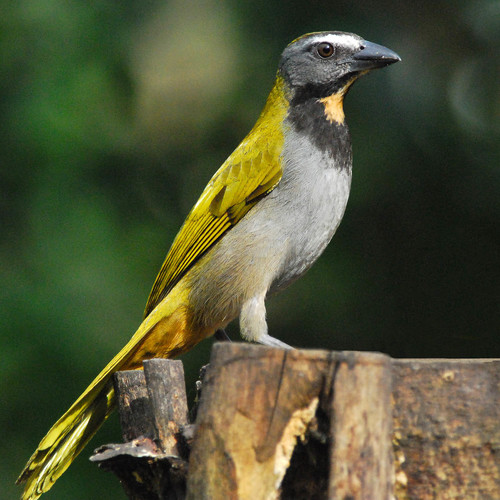
Buff-throated Saltator
Saltator maximus
A vocal and vibrant resident of the tropical forest edge, the Buff-throated Saltator is easily identified by its namesake throat patch and its rich, whistling song. These adaptable birds are a delight for backyard observers, frequently visiting fruit feeders across Central and South America.
Quick Identification
Size
21 cm (8.3 in) in length; weighs approximately 42–52 g (1.5–1.8 oz).
Colors
Olive-green upperparts, grey head and breast, with a prominent buffy-orange throat patch bordered by black malar stripes. Features a sharp white stripe above the eye.
Key Features
- Distinctive buff-orange throat patch with black borders
- Thick, heavy black seed-cracking bill
- Prominent white supercilium (eyebrow) stripe
- Olive-green back and wings contrasting with grey underparts
When You’ll See Them
Sightings on EverydayEarth
Jun 3, 2026
A variety of tropical birds are active around a fruit feeder in a lush forest. A female Thick-billed Euphonia hops along a moss-covered branch on the left, while a Clay-colored Thrush and a Buff-throated Saltator feed on sliced oranges and bananas on the main tray. A Blue-gray Tanager joins the group briefly, landing on the feeder as others depart.
Geographic range
Where Does the Buff-throated Saltator Live?
This species is a resident of the Neotropics, with a native range extending from southeastern Mexico through Central America and into northern South America. It is commonly found throughout the lowlands of Colombia, Venezuela, and the Guianas, reaching its southern limits in western Ecuador and the northeastern Amazon basin of Brazil. It thrives in humid environments and is a frequent sight in both pristine forest borders and modified agricultural landscapes.
Basemap © OpenStreetMap contributors
Behavior
The Buff-throated Saltator is a social and vocal bird, often recognized by its melodic, whistling song that is a staple of the tropical morning chorus. While they are members of the tanager family, they behave much like grosbeaks, using their powerful bills to process seeds and tough fruits. They are typically seen in pairs or small family groups, moving through the mid-canopy and garden shrubbery with deliberate, hopping movements.
Though they can be somewhat shy and prefer to stay within the safety of dense foliage, they are highly adaptable to human presence. In suburban environments, they become quite bold around fruit feeders and water baths. They are non-migratory residents, meaning they often maintain the same territory year-round, allowing backyard observers to build a relationship with a specific local pair over many seasons.
EverydayEarth exclusive
Camera Tips
To capture the Buff-throated Saltator on camera, the most effective strategy is to target their love for fruit. Use a platform feeder or a sturdy branch and offer overripe bananas, papaya, or plantains. Position your AI-powered camera 3 to 5 feet away from the bait to ensure the lens can resolve the fine details of the buff throat and the white eyebrow stripe. Since they are mid-story birds, mounting your camera at eye level (about 5 feet high) is more effective than ground-level placement.
Because these birds are most vocal and active in the early morning, ensure your camera's trigger speed is set to its fastest setting. They tend to land on a nearby 'sentry' branch before committing to a feeder; if you can identify this landing spot, aim your camera there to capture natural, candid behaviors like tail-flicking or singing. Avoid placing the camera where it faces the direct morning sun, as the high contrast can wash out the subtle olive tones of their plumage.
Water is another fantastic lure. A raised birdbath with a small dripper or solar fountain will attract saltators even if fruit isn't available. They are meticulous bathers and will often spend several minutes splashing, providing excellent opportunities for high-frame-rate video. During the breeding season (March–July), they are more territorial, so placing a camera near dense hedgerows where they might be nesting can yield sightings of them carrying nesting materials or food for fledglings.
Similar Species
Species that look similar or are commonly confused with Buff-throated Saltator.
Frequently Asked Questions
Record Buff-throated Saltator at your habitat
Connect a camera to start building your own species record — AI identifies every visitor automatically.