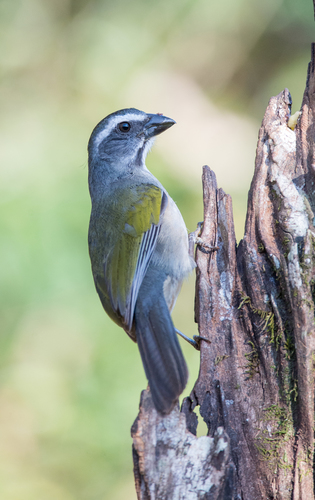
Green-winged Saltator
Saltator similis
A master of melody with a striking white eyebrow, the Green-winged Saltator is a beloved visitor to South American gardens. Watch for this olive-hued beauty as it flutters through the foliage in search of fresh fruit and the perfect perch.
Quick Identification
Size
Length: 20.5–21 cm (8–8.3 in); Weight: 36–54 g (1.3–1.9 oz)
Colors
Olive-green wings and back; grey head and nape; prominent white eyebrow stripe; white throat with thin black borders; buffy-grey underparts.
Key Features
- Distinctive long white eyebrow (supercilium)
- Olive-green mantle and wing feathers
- White throat framed by black malar stripes
- Thick, heavy grey beak with a slightly curved culmen
When You’ll See Them
Geographic range
Where Does the Green-winged Saltator Live?
The Green-winged Saltator is native to the vast landscapes of South America, primarily concentrated in the central and southeastern regions of the continent. Its core range encompasses a massive area across Brazil, Paraguay, and Uruguay, extending into the northern reaches of Argentina and the eastern lowlands of Bolivia. It is particularly abundant in the southern Cerrado and the Pantanal, where it thrives in the transition zones between dense forest and open savanna.
Basemap © OpenStreetMap contributors
Behavior
The Green-winged Saltator is a melodious and social songbird, often recognized more by its voice than its plumage. It possesses a rich, flute-like whistle that it uses to proclaim its territory from high perches within the canopy or forest edge. Unlike many other tropical birds that travel in large mixed-species flocks, this saltator is more commonly seen in pairs or small family groups, maintaining a relatively stable home range throughout the year.
In backyard settings, they exhibit a mix of caution and curiosity. They are known to be 'leaf-gleaners,' moving through foliage with deliberate, hopping movements rather than rapid, frantic flights. While they can be shy in the wild, they have adapted remarkably well to human-modified landscapes, frequently visiting suburban gardens, orchards, and parks where they can find a reliable supply of fruit and water. Their social interactions involve a lot of vocalizing, with pairs often performing duets to strengthen their bond.
EverydayEarth exclusive
Camera Tips
To capture high-quality footage of the Green-winged Saltator, focus your camera placement on transition zones—specifically where garden shrubs meet taller trees. These birds prefer to move through a vertical 'ladder' of vegetation rather than flying across wide-open spaces. Mounting your camera at a height of 5 to 7 feet, angled slightly downward toward a sturdy horizontal branch or a specialized platform feeder, will yield the best results. Because they are heavy-bodied birds, they prefer stable landing spots over swaying thin twigs.
Food is the ultimate motivator for this species. They are highly attracted to platform feeders stocked with sliced tropical fruits like papaya, bananas, and oranges. If you are using an AI-powered camera, position the fruit so the bird is forced to land sideways, giving the camera a clear view of its profile to identify the characteristic white eyebrow and olive wings. Water is also a powerful lure; a shallow, elevated bird bath with a small solar fountain will draw them in for spectacular bathing shots, especially during the hotter afternoon hours when they seek to cool down.
For the best lighting and activity levels, ensure your camera is active by dawn. Green-winged Saltators are among the first birds to wake, often visiting feeders in the soft, early morning light. If your camera has adjustable settings, a fast trigger speed is essential, as they can be surprisingly quick when jumping between branches. During the breeding season from September to December, you may capture interesting social behaviors, such as 'courtship feeding,' if you keep your camera focused on a consistent feeding station.
Similar Species
Species that look similar or are commonly confused with Green-winged Saltator.
Frequently Asked Questions
Record Green-winged Saltator at your habitat
Connect a camera to start building your own species record — AI identifies every visitor automatically.