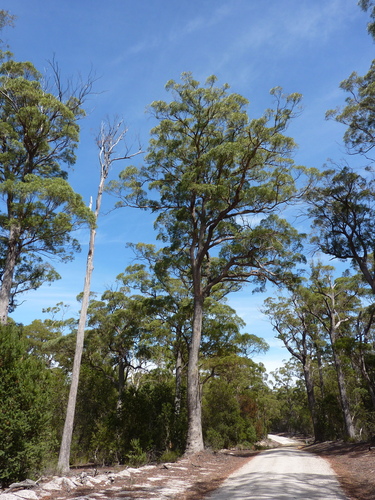
black peppermint
Eucalyptus amygdalina
A Tasmanian icon, the black peppermint is famous for its mint-scented leaves and elegant, weeping canopy. This hardy evergreen is a sanctuary for unique island wildlife and a cornerstone of Australia's cool-temperate woodlands.
Quick Identification
Size
Small to medium-sized tree reaching 10-30 metres (33-100 feet) in height.
Colors
Rough grey to grey-brown fibrous bark on the lower trunk, transitioning to smooth white, grey, or yellowish bark on upper branches; narrow green to blue-green leaves.
Key Features
- Distinct peppermint aroma when leaves are crushed
- Rough, finely fissured bark on lower trunk
- Narrow, lance-shaped to linear adult leaves
- Groups of 11 to 15 club-shaped flower buds
When You’ll See Them
Geographic range
Where Does the black peppermint Live?
The black peppermint is a proud endemic of Australia’s island state, Tasmania. It is widely distributed across the eastern and central parts of the island, from the coastal lowlands to the lower slopes of the central highlands. While it is most at home in the wild Tasmanian bush, it is also a common sight in suburban gardens and parks throughout Hobart and Launceston, where it has been preserved during urban development.
Basemap © OpenStreetMap contributors
Behavior
The black peppermint is a resilient and long-lived evergreen tree that defines much of the Tasmanian landscape. Unlike animals, its 'behavior' is observed through its growth cycles and its relationship with the environment. It is a fire-evolved species, often recovering from bushfires through epicormic shoots hidden beneath its thick bark. It plays a vital role in the ecosystem by providing a steady supply of nectar for native bees and honeyeaters during its summer flowering period.
In a backyard or woodland setting, the tree exhibits a graceful, often weeping habit as it matures. It is known for its heavy shed of fine, narrow leaves and small, woody gumnuts, which create a rich leaf litter layer that supports ground-dwelling invertebrates. Its bark is a micro-habitat in itself, often crawling with spiders and beetles that provide a food source for insectivorous birds.
EverydayEarth exclusive
Camera Tips
Capturing the black peppermint on camera is less about 'catching' the tree and more about documenting the vibrant life it supports. To capture the tree's stunning textures, place your camera about 2 metres (6 feet) from the trunk at chest height. Use a side-angled position to highlight the contrast between the rough, fibrous base bark and the smooth, pale upper bark. This area is a highway for arboreal mammals like Common Brushtail Possums and various skink species.
If you are using an AI-powered camera to detect wildlife, point the lens toward the mid-canopy during the flowering months of November through March. This is when the white blossoms attract a frenzy of activity from Yellow-throated Honeyeaters and Swift Parrots. A high-angle mount on a neighboring structure or a tall tripod will yield the best results for bird identification.
For those interested in the tree's own growth, time-lapse settings are ideal. Set your camera to take one photo every 24 hours to observe the shedding of bark strips or the slow opening of the woody fruit. Ensure your camera has a wide-angle lens if you want to capture the tree's full weeping silhouette against the sky. During the golden hour—shortly before sunset—the smooth upper bark can take on a beautiful golden or pinkish glow, making for professional-grade botanical photography.
Similar Species
Species that look similar or are commonly confused with black peppermint.
Frequently Asked Questions
Record black peppermint at your habitat
Connect a camera to start building your own species record — AI identifies every visitor automatically.