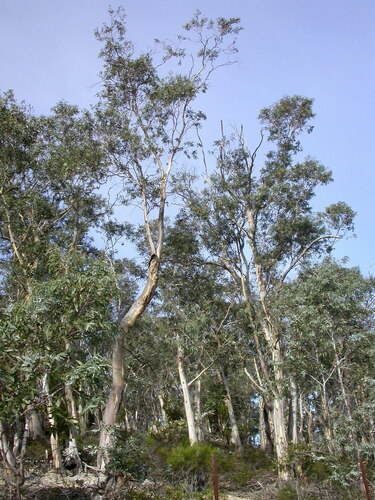
silver peppermint
Eucalyptus tenuiramis
A shimmering icon of the Tasmanian wilderness, the silver peppermint is beloved for its blue-hued, aromatic leaves and smooth, 'scribbled' bark. This endemic treasure transforms dry woodlands into silvery landscapes, providing a vital sanctuary for the island's unique bird and insect life.
Quick Identification
Size
Small to medium tree, typically 8–25 metres (26–82 feet) tall with a trunk diameter up to 0.6 metres (2 feet).
Colors
Mottled smooth bark in white, grey, and pale yellow; silvery-blue or glaucous foliage; creamy white flowers.
Key Features
- Strong peppermint aroma when leaves are crushed
- Silvery, blue-grey adult foliage with a waxy coating
- Smooth white, grey, or yellow bark often featuring insect 'scribbles'
- Flower buds arranged in distinct groups of 9 to 15
- Endemic only to the southeastern regions of Tasmania
When You’ll See Them
Geographic range
Where Does the silver peppermint Live?
Native to the island continent of Australia, the silver peppermint is a specialist endemic found exclusively in the southeastern corner of Tasmania. Its core range extends from the Tasman and Forestier Peninsulas through the Derwent Valley and into the Eastern Tiers. Because of its specific soil and climate requirements, it is not found naturally in the wild anywhere else in the world, though it is occasionally planted in cool-temperate gardens globally for its ornamental silvery foliage.
Basemap © OpenStreetMap contributors
Behavior
The silver peppermint is a resilient evergreen that plays a vital role in the dry sclerophyll forests of Tasmania. While it doesn't 'move' in the traditional sense, its growth pattern is characterized by a graceful, often weeping habit where the branches pendulously hang, showing off the silvery sheen of its leaves. It is a slow-to-moderate grower that has adapted to survive in nutrient-poor soils, using its deep root system to find stability and moisture in rocky terrain.
Ecologically, this tree acts as a focal point for local biodiversity. During its flowering season from late spring to early summer, it becomes a hive of activity, providing a massive nectar resource for native bees, beetles, and nectar-feeding birds. It is particularly known for its relationship with the 'scribbly gum moth' larvae, which leave distinctive zigzag tracks on its smooth bark as they feed, creating a unique natural artwork that is a hallmark of the species.
EverydayEarth exclusive
Camera Tips
To capture the best images of a silver peppermint, focus on the unique light-reflective quality of its foliage. Set your camera at an angle where the morning or late afternoon sun hits the leaves directly; the glaucous (waxy) coating reflects light, creating a shimmering 'silver' effect that is striking in time-lapse videos or high-resolution stills. If you are using an AI-powered camera to detect wildlife, position the lens about 2 to 3 metres up the trunk or facing a low-hanging branch to catch nectar-feeding birds like the Yellow-throated Honeyeater during the flowering peak between October and January.
Don't just look at the leaves—the bark is a micro-ecosystem. Mount a camera with a macro or close-focus capability about five feet high on the trunk to document the 'scribbles' left by moth larvae or the various lizards, such as the Tasmanian Tree Skink, that use the smooth bark for basking. Because the bark is very light in color, you may need to adjust your camera's exposure compensation to -0.7 or -1.0 to prevent the white sections from 'blowing out' or overexposing in bright sunlight.
For those interested in nocturnal visitors, the silver peppermint is a favorite haunt for common brushtail possums and sugar gliders. Place your camera on a nearby post or a neighboring tree facing the main fork of the silver peppermint. Use a low-intensity infrared flash to avoid startling the animals, as the reflective bark can bounce a standard flash back into the lens, causing a white-out. Setting the camera to take short 10-second video clips rather than photos will help you observe the agile movements of these marsupials as they navigate the smooth branches.
Finally, consider the wind. Peppermints are known for their weeping, flexible branches. On windy days, standard motion triggers might be set off constantly by moving foliage. Use AI-based 'animal only' detection settings if your camera supports it, or reduce the sensitivity of the PIR sensor during the day to ensure you are only capturing wildlife visitors rather than the tree dancing in the Tasmanian breeze.
Similar Species
Species that look similar or are commonly confused with silver peppermint.
Frequently Asked Questions
Record silver peppermint at your habitat
Connect a camera to start building your own species record — AI identifies every visitor automatically.