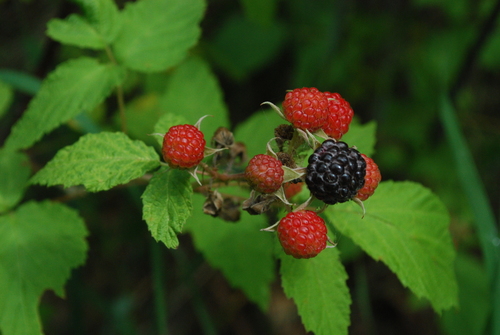
black raspberry
Rubus occidentalis
The black raspberry is a structural gem of the American backyard, recognizable by its arching purple canes and jewel-like summer fruit. It serves as a vital summer buffet for birds and a year-round fortress for small wildlife.
Quick Identification
Size
Canes typically 1 to 3 meters (3.3 to 10 feet) long; height 0.5 to 1.5 meters (2 to 5 feet) when arching.
Colors
Canes are deep purple to greenish with a waxy, bluish-white coating; fruit matures from green to red to a dull black.
Key Features
- Arching canes with a distinctive waxy, bluish-white 'bloom'
- Fruit is hollow when picked, leaving the core on the plant
- Compound leaves with 3 leaflets and silvery-white undersides
- Small, curved prickles along the stems
When You’ll See Them
Geographic range
Where Does the black raspberry Live?
Native to the temperate regions of eastern North America, the black raspberry thrives from southern Ontario and Quebec down through the eastern United States. Its core range extends westward to the edge of the Great Plains and southward into the Appalachian highlands of Georgia and Alabama. It is a common sight in both wild forest margins and semi-maintained suburban gardens throughout the Northeast and Midwest.
Basemap © OpenStreetMap contributors
Behavior
The black raspberry is a perennial shrub with a fascinating biennial growth pattern. In its first year, it produces 'primocanes'—vigorous, fast-growing stems that are purely vegetative. These canes often grow long enough to arch back to the ground; where the tip touches soil, it can sprout new roots, a process known as tip-rooting that allows the plant to 'walk' across a landscape. In the second year, these stems become 'floricanes,' developing lateral branches that produce flowers and the highly prized dark fruit before dying back at the end of the season.
Ecologically, the black raspberry acts as a pioneer species, often being among the first to colonize disturbed areas or forest clearings. It provides critical structure for backyard habitats, offering dense cover for nesting songbirds and small mammals. Its late-spring flowers are a vital nectar source for native bees and honeybees, while its mid-summer berries are a high-energy food source for dozens of bird species and mammals ranging from chipmunks to black bears.
EverydayEarth exclusive
Camera Tips
Capturing the black raspberry on a trail camera is a unique challenge that rewards those who focus on the plant's role as a 'wildlife hub.' To document the plant's development, use a time-lapse setting during May and June. Mount your camera on a sturdy post or stake approximately 3 feet away from a flowering cluster. This allows you to see the blossoms transition into berries. Be mindful of the wind; the long, arching canes of the black raspberry are prone to swaying, which can trigger hundreds of false motion events. If your camera allows it, reduce the motion sensitivity or use 'zone detection' to focus only on the fruit-heavy areas of the frame.
The most exciting time for camera placement is during the ripening window in July. Position your camera at 'bird-eye level'—about 2 to 4 feet off the ground—and angle it slightly downward toward a cluster of ripe, black fruit. This is the prime setup for capturing fruit-eating birds like Gray Catbirds, Cedar Waxwings, and Northern Cardinals. Because the berries are dark, they can sometimes disappear in shadows; try to position the camera so the sun is behind it, illuminating the berries during the morning or late afternoon when bird activity is at its peak.
For those interested in mammalian visitors, place a camera near the base of the thicket. Many small mammals like Eastern Chipmunks and Opossums will scavenge fallen berries or climb the lower canes. If you have a camera with a high-quality macro or close-focus lens, the waxy purple canes and the intricate patterns of the prickles make for stunning nighttime infrared shots. In the winter, the plant's distinctive purple color stands out against the snow, providing a beautiful backdrop for capturing foraging winter birds like Dark-eyed Juncos searching for remaining seeds or shelter.
Similar Species
Species that look similar or are commonly confused with black raspberry.
Frequently Asked Questions
Record black raspberry at your habitat
Connect a camera to start building your own species record — AI identifies every visitor automatically.