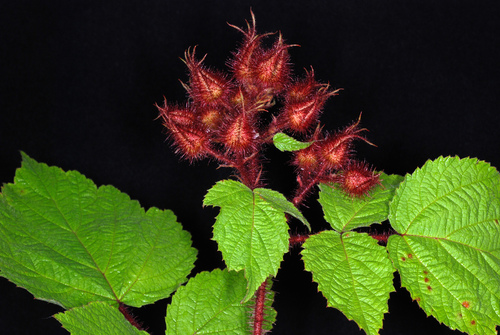
wineberry
Rubus phoenicolasius
With its jewel-like fruit and distinctively 'fuzzy' red stems, the wineberry is a striking presence in the summer garden. Whether you're a forager or a birdwatcher, this invasive but beautiful raspberry relative is a hub of backyard activity.
Quick Identification
Size
Canes typically grow 3–9 feet (1–3 meters) long; fruit clusters are approximately 0.4 inches (1 cm) in diameter.
Colors
Bright lime-green leaves with silvery-white undersides; stems covered in distinctive reddish-purple glandular hairs; fruit transitions from green to bright orange-red.
Key Features
- Stems and flower buds covered in dense, reddish-purple 'fur' or glandular hairs
- Leaves arranged in groups of three with a distinct heart-shaped terminal leaflet
- Silvery-white felt-like texture on the underside of leaves
- Jewel-like, sticky red berries that pull away from a central core when ripe
When You’ll See Them
Behavior
The wineberry is a vigorous, multi-stemmed shrub that belongs to the bramble family. It exhibits a biennial growth habit, meaning its life cycle takes two years to complete. In the first year, it produces vegetative canes known as primocanes that do not flower. In the second year, these canes become floricanes, developing small, greenish flowers that eventually give way to the iconic sweet, tart berries. Its growth is aggressive; it often spreads via 'tip-rooting,' where the ends of long, arching canes touch the ground and sprout new root systems.
As an introduced species in North America, wineberry has become highly successful in the wild and in suburban backyards alike. It forms dense thickets that provide excellent cover for small mammals and nesting sites for birds. While it is considered invasive in many regions due to its ability to outcompete native flora, it remains a favorite for foragers and wildlife enthusiasts who appreciate its heavy fruit production and the array of pollinators it attracts during the spring blooming season.
EverydayEarth exclusive
Camera Tips
Capturing the wineberry on your backyard camera is less about the plant’s movement and more about the incredible 'traffic' it attracts. To get the best results, mount your camera on a stake or a nearby tree approximately 3 to 4 feet off the ground, angled slightly downward toward a cluster of ripening berries. Because the berries are a magnet for Gray Catbirds, Northern Cardinals, and even Box Turtles, you’ll want to set your camera to 'Burst Mode' or high-speed video to capture the quick, decisive movements of these animals as they snatch the fruit.
If you are using a trail camera with a macro or close-focus lens, aim for the distinctive red, hairy stems. These glandular hairs are visually striking and provide a great deal of texture in high-resolution photos, especially in the early morning when dew clings to them. For lighting, the wineberry looks its best in the 'golden hour'—just after sunrise or before sunset—when the low-angle sun illuminates the translucent red berries and the silvery undersides of the leaves, making them pop against the green backdrop of the forest edge.
Since wineberry is a favorite for nocturnal foragers like Raccoons and Opossums, don’t turn your camera off at night. These mammals will often visit the patch under the cover of darkness to feast. Use a camera with a 'No-Glow' infrared flash to avoid spooking these visitors. If you are specifically looking to film the fruit ripening, consider setting up a time-lapse over a period of 10 to 14 days in early July; you’ll see the hairy calyx open up to reveal the green fruit, which then blushes into a deep, glossy red.
In the winter months, the wineberry remains a great photographic subject because of its vibrant red canes, which stand out sharply against the snow. During this time, position your camera to face the thickest part of the bramble patch. Small birds like Juncos and Sparrows often use these thorny thickets as thermal cover during winter storms, and you can capture some wonderful 'life in the brush' footage by keeping your camera active even after the berries are long gone.
Similar Species
Species that look similar or are commonly confused with wineberry.
Frequently Asked Questions
Record wineberry at your habitat
Connect a camera to start building your own species record — AI identifies every visitor automatically.