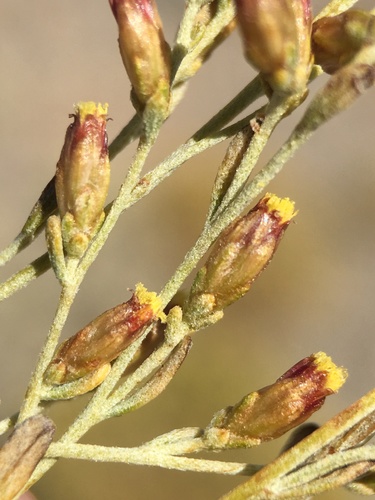
Black Sagebrush
Artemisia nova
The resilient Black Sagebrush is a master of the rocky high desert, providing a critical winter lifeline for Pronghorn and Sage-Grouse alike. Its dark, aromatic foliage stands as a testament to life’s ability to thrive in the harshest Western landscapes.
Quick Identification
Size
Height ranges from 10 to 50 cm (4 to 20 inches), typically wider than it is tall
Colors
Dark olive-green to charcoal-black leaves; brownish-yellow flowers; dark, woody stems
Key Features
- Low-growing, spreading dwarf shrub habit
- Sticky, glandular leaf surfaces without dense grey fuzz
- Three-lobed leaf tips (tridentate)
- Strong, pungent, spicy aroma when crushed
When You’ll See Them
Geographic range
Where Does the Black Sagebrush Live?
Black Sagebrush is a quintessential inhabitant of the North American West, thriving in the rugged Intermountain Region. Its native range is centered in the Great Basin, extending from the eastern slopes of the Sierra Nevada in California across Nevada and Utah into Western Colorado. It reaches northward into the plains of Montana and Idaho and stretches south into the high-elevation deserts of Arizona and New Mexico. It is almost exclusively found in the United States, particularly in areas where limestone-derived soils prevent taller sagebrush species from dominating.
Basemap © OpenStreetMap contributors
Behavior
Black Sagebrush is a perennial evergreen shrub that serves as a cornerstone of the high-desert ecosystem in the Western United States. Unlike its larger relative, the Big Sagebrush, this species is specifically adapted to the harshest, most nutrient-poor environments. It grows slowly, often taking decades to reach its modest full size, and is exceptionally drought-tolerant. Its root system is designed to navigate shallow, rocky soils, anchoring the plant against the high winds of the open plains and mountain ridges.
While it may appear stationary, Black Sagebrush is a hub of biological interaction. It produces a suite of chemical compounds and essential oils that serve as a defense against some herbivores while making it highly palatable and nutritious for others. During the winter, it becomes an essential survival food. It does not go dormant in the traditional sense; it remains evergreen, providing a constant source of protein and fats for the animals that rely on it during the leanest months of the year.
EverydayEarth exclusive
Camera Tips
To capture the essence of Black Sagebrush on camera, you must focus on its role as a wildlife magnet. Place your camera on a low tripod or stake, roughly 12 to 20 inches off the ground, aimed at a healthy cluster of these shrubs. This perspective captures the intricate, glandular texture of the leaves and provides the perfect angle for the small animals that visit the plant. Because Black Sagebrush thrives in high-wind areas, use a fast shutter speed or a 'burst' photo mode to prevent motion blur from the swaying branches.
Winter is the prime season for trail camera monitoring near Black Sagebrush. Because it is a 'preferred browse' species, Mule Deer and Pronghorn will seek it out when other vegetation is buried under snow. Position your camera to face North or Northeast to avoid the harsh, direct sun of the high desert, which can cause 'white-out' highlights on the plant's dark foliage. Use the motion-trigger setting with a short recovery time to capture the social interactions of herds feeding on the shrub.
For those interested in birdlife, Black Sagebrush is a frequent haunt for the Greater Sage-Grouse. These birds use the low canopy for both cover and feeding. If you spot Sage-Grouse tracks or droppings near a patch of Black Sagebrush, set your camera for video mode. This will allow you to see the birds' unique foraging behavior as they selectively pick the most nutrient-dense leaves from the plant. No artificial lures are needed; the natural pungent oils of the sage are all the attraction necessary for local wildlife.
Similar Species
Species that look similar or are commonly confused with Black Sagebrush.
Frequently Asked Questions
Record Black Sagebrush at your habitat
Connect a camera to start building your own species record — AI identifies every visitor automatically.