Black sallee
Eucalyptus stellulata
A hardy specialist of the Australian high country, the Black Sallee is famous for its striking olive-green bark and its unique ability to thrive in the coldest frost hollows.
Quick Identification
Size
Typically 5-15 metres (16-50 feet) tall, occasionally reaching 20 metres in sheltered locations.
Colors
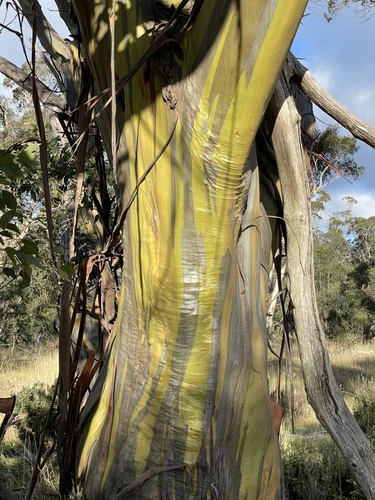
Dark grey to black rough bark at the base; smooth olive-green, yellowish, or lead-grey bark on upper branches; dark green glossy leaves.
Key Features
- Dark, deeply fissured rough bark on the lower trunk
- Smooth, greenish-yellow bark on upper branches that peels in ribbons
- Leaves feature 3 or more distinct longitudinal veins running parallel to the midrib
- Flower buds arranged in star-like clusters of 9 to 15.
When You’ll See Them
Geographic range
Where Does the Black sallee Live?
Native to the Australian continent, the Black Sallee is a specialist of the south-eastern highlands. Its core range spans the Great Dividing Range from the New England Tableland in New South Wales down through the Snowy Mountains and into the eastern Victorian Alps. It is almost exclusively found in high-country regions where cold air drainage creates a challenging environment for other vegetation.
Basemap © OpenStreetMap contributors
Behavior
The Black Sallee is a resilient evergreen tree known for its remarkable ability to withstand extreme cold and waterlogged soils. Unlike many other eucalypts, it thrives in 'frost hollows'—low-lying areas in alpine valleys where cold air settles, creating temperatures too low for most species. It grows both as a single-trunked tree and a multi-stemmed mallee, depending on the severity of the local climate and history of fire or grazing.
Ecologically, the Black Sallee plays a vital role in its high-altitude habitat. During its summer flowering period, it becomes a hub of activity, providing a rich nectar source for high-country honeyeaters, bees, and other pollinators. Its dense canopy offers shelter for subalpine birds, while older specimens develop small hollows that provide nesting sites for specialized alpine fauna. It is a slow-growing but long-lived species that defines the aesthetic of the Australian southern highlands.
EverydayEarth exclusive
Camera Tips
Capturing the Black Sallee on camera is best approached as a study of texture and seasonal change. To highlight the tree's namesake feature, position your camera at a low angle to capture the stark contrast between the black, rugged 'stocking' of bark at the base and the luminous, olive-green smooth bark above. Use a camera with high dynamic range settings if possible, as the bright green bark can easily blow out against a dark forest floor.
For those interested in the wildlife that visits the tree, mount your camera 2-3 metres up a sturdy branch during the summer months (December to February). This is when the white flowers bloom, attracting a variety of honeyeaters and insects. A fast shutter speed is essential here to freeze the motion of nectar-feeding birds. If your camera has a time-lapse mode, point it at the upper trunk during spring; you can capture the dramatic 'ribboning' effect as the old bark peels away to reveal the fresh, colorful layer beneath.
Don't ignore the night-time potential. Many arboreal mammals, such as the Sugar Glider or Common Ringtail Possum, frequent these trees for shelter. Use an infrared flash to avoid startling the animals, and aim the camera toward the junction of large branches where hollows are most likely to form. Because the Black Sallee often grows in damp areas, ensure your camera housing is rated for high humidity and frequent frost to prevent lens fogging during the early morning hours.
Similar Species
Species that look similar or are commonly confused with Black sallee.
Frequently Asked Questions
Record Black sallee at your habitat
Connect a camera to start building your own species record — AI identifies every visitor automatically.