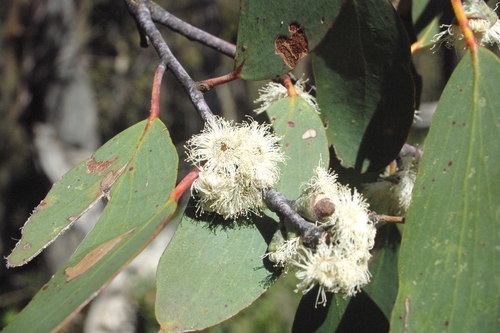
Snow Gum
Eucalyptus pauciflora
The Snow Gum is Australia's resilient alpine icon, famous for its twisted, multi-colored bark and its ability to withstand the harshest mountain winters. A vital sanctuary for high-altitude wildlife, it stands as a sentinel of the Great Dividing Range.
Quick Identification
Size
4-20 metres (13-65 feet) in height; trunk diameter up to 1 metre (3.3 feet)
Colors
White, cream, grey, and olive-green smooth bark, often featuring red or yellow hues and zig-zag 'scribble' markings
Key Features
- Smooth, multi-colored bark that peels in ribbons
- Thick, waxy lance-shaped leaves with parallel veins
- Clusters of 7-15 white, star-burst flowers
- Exceptional frost and snow tolerance with twisted, sturdy limbs
When You’ll See Them
Geographic range
Where Does the Snow Gum Live?
The Snow Gum is native to the southeastern corner of the Australian continent. Its range extends from the high country of southern Queensland, through the Great Dividing Range in New South Wales and the Australian Capital Territory, into the Victorian Alps and across much of Tasmania. It is the defining tree of the Australian alpine tree line, thriving where other eucalypts cannot survive the freezing temperatures.
Basemap © OpenStreetMap contributors
Behavior
The Snow Gum is a master of survival in Australia's harshest high-altitude environments. Unlike many trees that snap under the weight of winter precipitation, its branches are remarkably flexible and often grow in twisted, kontorted shapes to shed heavy snow. It has a unique symbiotic relationship with the 'Scribble Moth' (Ogmograptis scribula), whose larvae leave distinctive zig-zag tracks across the smooth bark as they feed, creating a natural art gallery on every trunk.
As a keystone species, it provides critical infrastructure for alpine ecosystems. During the summer, it produces nectar-rich flowers that attract a frenzy of insect and bird life. Its hollows, which take decades to form, serve as essential nesting sites for high-country specialists like the Leadbeater’s Possum and various parrot species. Even in death, the Snow Gum's dense, slow-rotting wood provides shelter for reptiles and invertebrates on the forest floor.
EverydayEarth exclusive
Camera Tips
When setting up a camera to capture the beauty of a Snow Gum, focus on the bark texture and the wildlife it hosts. Position your camera about 1.5 metres (5 feet) from the trunk to capture the intricate 'scribbles' left by moth larvae. If you are looking for wildlife, place the camera near a hollow or a flowering branch during the late spring. The white flowers are a magnet for honeyeaters and insects, making for excellent high-speed trigger opportunities.
Because Snow Gums often live in high-glare environments with white snow or bright granite, adjust your camera's exposure compensation to -0.5 or -1.0 to prevent the white bark from appearing 'blown out' or overexposed. If your camera supports time-lapse, set it to capture the peeling of the bark in late summer, when the old grey skin falls away to reveal vibrant oranges and creams underneath.
For backyard enthusiasts in cool climates, Snow Gums are perfect 'stage' trees. Mount your camera on a nearby post facing the tree's lower limbs. This is where birds like the Flame Robin often perch while hunting. During winter, ensure your camera has lithium batteries, as standard alkaline batteries will fail in the freezing temperatures where Snow Gums thrive. A wide-angle lens is best if you want to capture the tree's iconic twisted silhouette against a mountain sunset.
Similar Species
Species that look similar or are commonly confused with Snow Gum.
Frequently Asked Questions
Record Snow Gum at your habitat
Connect a camera to start building your own species record — AI identifies every visitor automatically.