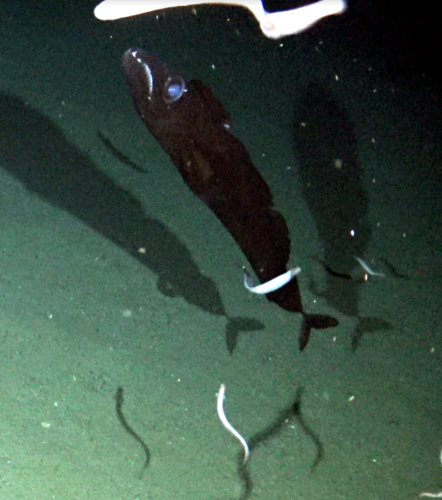
Black Scabbardfish
Aphanopus carbo
A mysterious ribbon of the abyss, the Black Scabbardfish is a deep-sea marvel known for its jet-black skin and piercing green eyes. Navigating the dark Atlantic depths, this formidable predator is a master of the midnight hunt.
Quick Identification
Size
Up to 110 cm (3.6 ft) in length; typically weighs between 1.5 to 3 kg (3.3 to 6.6 lbs).
Colors
Uniformly jet-black or coppery-black with a highly iridescent sheen that fades after death; large, luminous green eyes.
Key Features
- Elongated, ribbon-like body shape
- Large fang-like teeth in a prominent mouth
- Jet-black skin entirely lacking scales
- Massive, striking green eyes adapted for low light
When You’ll See Them
Geographic range
Where Does the Black Scabbardfish Live?
The Black Scabbardfish is a true specialist of the North Atlantic Ocean, thriving in the deep waters that bridge the continents. Its core populations are concentrated along the Mid-Atlantic Ridge and the continental slopes of Europe and Northwest Africa, with significant presence around the Madeira archipelago, the Canary Islands, and the coast of Portugal. While it is occasionally found as far north as Iceland and the Faroe Islands, its range extends westward toward the deep canyons off the Atlantic coast of the United States and Canada.
Basemap © OpenStreetMap contributors
Behavior
The Black Scabbardfish is an enigmatic deep-sea predator that exhibits a fascinating behavior known as diel vertical migration. During the daylight hours, these fish remain in the crushing pressures of the bathypelagic zone, often resting at depths of nearly 1,700 meters. As night falls, they rise through the water column to shallower depths (around 200 to 500 meters) to hunt, following the movement of the plankton and smaller organisms they prey upon.
Despite their monstrous appearance, they are not aggressive toward humans, primarily because their natural habitat is far beyond the reach of casual swimmers. In their deep-water environment, they are efficient, solitary hunters, using their highly developed eyesight and lateral line system to detect the vibrations and silhouettes of prey in the near-total darkness of the 'twilight zone.'
EverydayEarth exclusive
Camera Tips
Capturing a Black Scabbardfish on camera is a challenge reserved for the most ambitious citizen scientists, as it requires a Baited Remote Underwater Video (BRUV) system or a deep-rated ROV. To see one, your gear must be capable of withstanding extreme pressure and functioning at depths of at least 200 to 500 meters. Because these fish migrate vertically, your best chance for a clear shot is at night when they move closer to the surface, though they still remain far deeper than any backyard pond or coastal pier.
Placement is everything; aim to deploy your camera rig along the edge of a continental shelf or a steep underwater drop-off. Use a heavy-duty housing and an external battery pack to ensure the camera can record for several hours in the cold, deep water. Since the Black Scabbardfish has incredibly sensitive eyes, avoid using bright white LED lights which may startle them. Instead, utilize red or far-red lighting, which is nearly invisible to many deep-sea species but will still allow your sensor to capture their sleek, black silhouettes.
Bait is essential to bring this predator into the camera's field of view. A mesh bag filled with oily fish like mackerel or sardines works best, as the scent trail will drift through the currents and draw the Scabbardfish in from the darkness. Secure the bait about one meter in front of the lens to ensure the fish is in focus when it strikes. Given their speed, set your camera to a high frame rate (at least 60fps) if your lighting allows, as their movements can be surprisingly quick and serpentine when they feed.
Similar Species
Species that look similar or are commonly confused with Black Scabbardfish.
Frequently Asked Questions
Record Black Scabbardfish at your habitat
Connect a camera to start building your own species record — AI identifies every visitor automatically.