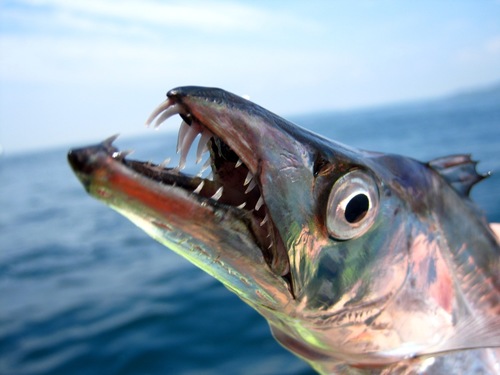
Largehead Hairtail
Trichiurus lepturus
A shimmering silver ribbon of the deep, the Largehead Hairtail is a fierce predator known for its fang-like teeth and haunting vertical swimming posture. Found in coastal waters worldwide, it is a master of the night-time ambush.
Quick Identification
Size
Typically 50–100 cm (1.6–3.3 ft) in length, though specimens can reach 234 cm (7.7 ft); weights up to 5 kg (11 lbs).
Colors
Brilliant metallic silver overall; fins may have a yellowish tinge; turns lead-gray after death.
Key Features
- Elongated, ribbon-like body tapering to a hair-like point
- Large mouth filled with prominent, barbed fang-like teeth
- Single continuous dorsal fin running the entire length of the back
- Complete absence of pelvic and caudal (tail) fins
- Large, highly reflective eyes for hunting in low light
When You’ll See Them
Geographic range
Where Does the Largehead Hairtail Live?
Native to the tropical and temperate waters of all major oceans, the Largehead Hairtail boasts one of the widest distributions of any marine fish. They are found extensively along the Atlantic coasts of both North and South America, from the United States to Argentina, and are equally abundant across the Indo-Pacific region, including the waters of East Africa, India, and Australia. In the Northwest Pacific, they represent a vital species for China, Japan, and Korea, often thriving in the brackish waters of large estuaries where river systems meet the sea.
Basemap © OpenStreetMap contributors
Behavior
The Largehead Hairtail is a sophisticated marine predator characterized by its unusual vertical swimming style. Unlike most fish that swim horizontally, hairtails often hang vertically in the water column, undulating their long dorsal fins to stay suspended while waiting to ambush prey from below. They are highly migratory, moving toward the surface at night to feed and retreating to deeper waters or the sea floor during the day to avoid larger predators.
These fish are known for their aggressive nature and school in massive numbers, which makes them a primary target for commercial fisheries worldwide. Within these schools, a complex social hierarchy exists based on size; interestingly, large adults are known to be cannibalistic, often feeding on smaller juveniles of their own species. For coastal residents, they are most frequently encountered around piers and docks where artificial lights attract the smaller fish they hunt.
EverydayEarth exclusive
Camera Tips
To capture the Largehead Hairtail on camera, you will need a waterproof underwater housing or a specialized submersible trail camera. Because these fish are highly attracted to light, the most effective strategy is to mount your camera near a 'green light' fishing system or a submersible LED beacon. These lights attract plankton and small baitfish, which in turn draw the predatory hairtails directly into your camera's field of view. Coastal piers and public docks are ideal mounting locations, as they provide the structural support needed to secure a camera rig.
Set your camera to record at a high frame rate, such as 60 or 120 fps, to capture the hypnotic, ribbon-like undulation of their bodies. Position the camera at a depth of 2 to 4 meters, facing slightly upward to catch the metallic silver reflection of their scales against the ambient surface light. Using a wide-angle lens is beneficial, as hairtails can be quite long and may easily swim out of a narrow frame. If you are in a tidal area, ensure your camera is positioned deep enough to remain submerged during low tide but shallow enough to stay within the 'active zone' near the surface during the night.
For the best results, use a scent lure in conjunction with your light. A perforated PVC pipe filled with crushed sardines or mackerel, placed just out of the frame, will keep the hairtails circling the area for longer periods. Be mindful of the moon cycle; hairtails are often more aggressive and easier to film on darker nights when artificial lights become the primary attractant in the water. Always rinse your camera housing with fresh water after deployment to prevent saltwater corrosion of the seals and lenses.
Similar Species
Species that look similar or are commonly confused with Largehead Hairtail.
Frequently Asked Questions
Record Largehead Hairtail at your habitat
Connect a camera to start building your own species record — AI identifies every visitor automatically.