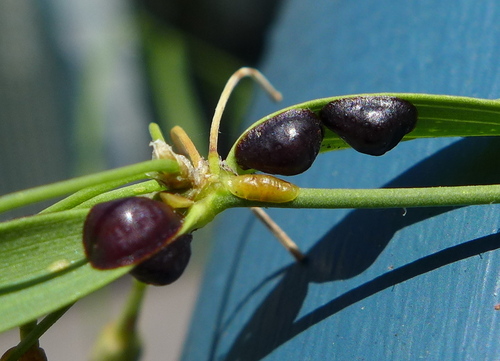
Black Scale
Parasaissetia nigra
The Black Scale is a master of sedentary survival, transforming from a tiny crawler into a glossy, shield-like sentinel of the garden. Often found in the company of protective ants, this resilient insect is a fascinating example of nature's complex symbioses.
Quick Identification
Size
Adults measure 3-5 mm (0.12-0.20 in) in length and 2-3.5 mm (0.08-0.14 in) in width.
Colors
Mature adults are a glossy jet-black or deep mahogany; younger nymphs appear yellowish-brown or translucent.
Key Features
- Elongated oval, shield-like body shape
- Glossy, smooth dorsal surface when mature
- Distinctive 'H' shaped ridge visible during the nymph stage
- Usually found clustered on stems or along leaf midribs
When You’ll See Them
Geographic range
Where Does the Black Scale Live?
Originally native to the African continent, the Black Scale has become a cosmopolitan species through the global trade of ornamental plants. It is now common throughout the tropical and subtropical regions of the world, with significant populations in the southern United States, Central America, the Caribbean, and across Southeast Asia and Australia. In cooler climates, it thrives as a persistent resident of indoor greenhouses and heated botanical gardens.
Basemap © OpenStreetMap contributors
Behavior
The Black Scale is a sedentary insect that spends the majority of its life fixed in one spot. Once the mobile 'crawler' stage finds a suitable location on a host plant, it inserts its piercing-sucking mouthparts into the tissue to feed on sap. As it grows, it secretes a hard, waxy shell that protects it from predators and environmental stress. This species is primarily parthenogenetic, meaning females can produce offspring without mating, allowing a single individual to rapidly start a colony.
These insects are famous for their symbiotic relationship with various ant species. As they process large amounts of plant sap, they excrete a sugary liquid known as honeydew. Ants 'farm' the scale, protecting them from ladybugs and parasitic wasps in exchange for the honeydew. This behavior often leads to the growth of black sooty mold on the leaves below the colony, which can eventually harm the host plant by blocking sunlight.
EverydayEarth exclusive
Camera Tips
Capturing the Black Scale on a backyard camera requires a macro lens or a specialized AI-powered camera designed for close-range insect observation. Because these insects are stationary, your camera placement is the most critical factor. Focus your lens on the stems, woody twigs, or the undersides of leaves of known host plants like hibiscus, oleander, or citrus trees. Ensure the camera is mounted on a stable surface or tripod, as even minor vibrations will cause blur at the high magnification levels needed to see the scale's features.
The best way to 'find the action' with these stationary insects is to watch for ants. If you notice ants marching in a line up a branch, they are likely leading you directly to a scale colony. Position your camera to capture the interaction between the ants and the Black Scale. This provides dynamic footage of the ants 'milking' the scale for honeydew, which is far more engaging than a static image of the scale alone. Use an external LED light source to illuminate the plant from the side, which helps highlight the glossy texture and 'H' ridge of the scale's shell.
For those interested in the life cycle, use a time-lapse setting. By taking one photo every hour over several weeks, you can document the growth of the scale from a tiny, pale crawler to a large, glossy black adult. This also allows you to see the gradual buildup of sooty mold on the surrounding leaves. Ensure your camera is protected from direct rain, as water droplets on the lens will obscure these tiny subjects, but high humidity is often when the insects are most healthy and visually distinct.
Similar Species
Species that look similar or are commonly confused with Black Scale.
Frequently Asked Questions
Record Black Scale at your habitat
Connect a camera to start building your own species record — AI identifies every visitor automatically.