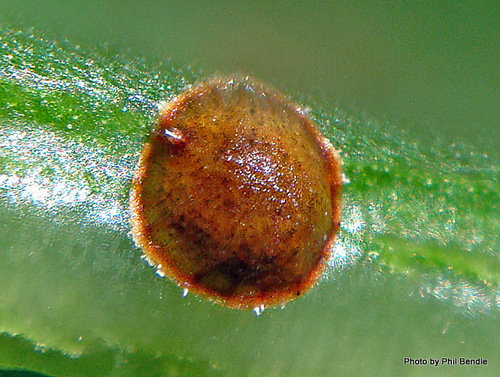
Hemispherical Scale
Saissetia coffeae
Resembling tiny, polished mahogany helmets, the Hemispherical Scale is a master of the stationary life. These glossy insects turn garden stems into miniature hubs of activity, attracting ants and creating complex micro-ecosystems in your backyard.
Quick Identification
Size
Adult females typically range from 2 to 4 mm (0.08 to 0.16 inches) in length and approximately 1 to 2 mm in height.
Colors
Rich mahogany or reddish-brown; the surface is exceptionally smooth and glossy, often looking like a polished bead or a tiny drop of brown wax.
Key Features
- Highly convex, dome-like 'helmet' shape
- Smooth, shiny exterior without prominent ridges or bumps
- Stationary adult stage usually found clustered on stems or leaf midribs
When You’ll See Them
Behavior
The Hemispherical Scale is a fascinating example of a 'sessile' insect. Once the young 'crawlers' find a suitable spot on a host plant, the females settle down permanently, tucking their legs beneath them and secreting a hard, waxy shell for protection. They spend their entire adult lives in this single spot, acting as tiny pumps that draw sap from the plant's vascular system. This stationary lifestyle makes them easy to miss if you aren't looking closely, as they often blend in with the bumps and nodes of the plant stems.
As they feed on plant phloem, they excrete a sugary substance known as honeydew. This byproduct is highly sought after by ants, which will often 'farm' the scales, protecting them from predatory ladybugs and wasps in exchange for the sweet reward. If you see a line of ants marching up a plant stem, they are likely heading toward a colony of Hemispherical Scale. While they are considered a pest in coffee and citrus groves, in a backyard setting, they provide a unique window into complex insect symbioses and the hidden world of plant parasites.
EverydayEarth exclusive
Camera Tips
Capturing the Hemispherical Scale requires a specialized approach because they are stationary and very small. You will need a camera with a dedicated macro mode or a macro lens attachment. Because they don't move, you have the luxury of time to set up the perfect shot. Position your camera on a tripod or a stable mount just a few inches from the infested stem. A side-on angle is best for showcasing their namesake hemispherical profile, which looks remarkably like a miniature tortoise shell or a polished helmet.
Since these insects are often found on the underside of leaves or in the shadows of dense foliage, lighting is your biggest challenge. Use a ring light or a diffused LED panel to bring out the glossy, mahogany sheen of their shells. Avoid direct, harsh flash, which can create a distracting white 'hot spot' on their reflective surface. Early morning light provides a soft, natural glow that highlights the texture of the plant and the insect simultaneously.
To capture 'action' shots, focus your camera on a cluster of scales and wait for ant visitors. AI-powered cameras with motion detection may not trigger on the scales themselves, but they will certainly trigger on the ants. Set your camera to take high-resolution bursts or a short video clip when it detects the movement of ants. This allows you to document the 'milking' process where ants tap the scales with their antennae to stimulate honeydew production.
Time-lapse photography is another excellent way to observe this species over several days. You can record the slow maturation of the crawlers or the gradual accumulation of 'sooty mold'—a black fungus that often grows on the honeydew the scales leave behind. Set your interval to one frame every 15-30 minutes for a fascinating look at how the colony interacts with the host plant over a week.
When choosing a location, look for host plants like ferns, citrus trees, hibiscus, or coffee plants. The stems and the undersides of leaves along the main veins are the prime 'real estate' for these insects. If you find a plant with sticky leaves, follow the trail upward; the scales are usually located directly above the sticky residue.
Similar Species
Species that look similar or are commonly confused with Hemispherical Scale.
Frequently Asked Questions
Record Hemispherical Scale at your habitat
Connect a camera to start building your own species record — AI identifies every visitor automatically.