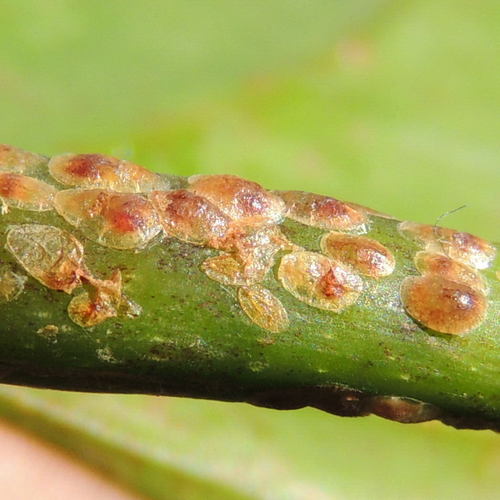
Brown Soft Scale
Coccus hesperidum
A tiny but resilient master of disguise, the brown soft scale is a master at blending into the stems and leaves of your favorite plants. Though often viewed as a pest, its complex relationship with ants and unique life cycle make it a fascinating subject for backyard macro-observation.
Quick Identification
Size
3–5 mm (0.12–0.20 inches) in length; 2–3 mm (0.08–0.12 inches) in width
Colors
Yellowish-green to yellowish-brown, often speckled with darker brown spots that intensify as the insect matures
Key Features
- Flattened oval or pear-shaped body
- Pale mottled brown or yellowish-green coloration
- Lack of a detachable waxy shell
- Usually found clustered along leaf veins or green stems
When You’ll See Them
Geographic range
Where Does the Brown Soft Scale Live?
Originally native to the tropical and subtropical regions of Asia, the brown soft scale has become a truly cosmopolitan species thanks to the global plant trade. It is now found across every continent except Antarctica, thriving particularly well in the southern United States, the Mediterranean, and throughout Southeast Asia. In cooler temperate climates, it maintains a strong presence as a persistent inhabitant of heated greenhouses and indoor botanical collections where outdoor winters would otherwise be too harsh.
Basemap © OpenStreetMap contributors
Behavior
Brown soft scales are fascinating but often unwelcome guests in the garden. Unlike many other insects, the adult females are largely sedentary, spending nearly their entire lives attached to a single spot on a plant's stem or leaf. They use specialized, needle-like mouthparts to pierce the plant tissue and drink the nutrient-rich phloem sap. This feeding process produces a sticky, sugary waste product known as honeydew, which coats the surrounding foliage and can lead to the growth of black sooty mold.
The relationship between these scales and ants is a classic example of mutualism. Ants often 'farm' the scales, aggressively protecting them from predatory ladybugs and parasitic wasps in exchange for the sweet honeydew. While they may appear lifeless, brown soft scales are highly prolific; in many regions, they give birth to live young called 'crawlers.' These tiny, mobile nymphs are the primary way the species spreads, hitching rides on the wind, birds, or human clothing to find a new host plant.
EverydayEarth exclusive
Camera Tips
Capturing the brown soft scale on camera requires a different approach than filming birds or mammals. Because these insects are tiny and mostly stationary, you need a camera capable of macro photography or a lens attachment designed for extreme close-ups. Position your camera just inches away from the undersides of leaves or along the green stems of host plants like citrus or hibiscus. A stable mounting system or tripod is essential, as even a slight breeze can cause the plant to move out of focus, ruining a high-magnification shot.
To see real 'action,' look for the presence of ants. Ants are often the best indicators of a scale infestation. If you see a trail of ants moving up and down a branch, follow them; they will lead you directly to the scale colony. Setting your camera to record time-lapse or high-frame-rate video near these ant trails can reveal the fascinating interactions between the two species, including the ants 'milking' the scales for honeydew and fending off potential predators.
Lighting is your biggest challenge for such small, often shadowed subjects. Use an external LED light source to provide consistent illumination, as the shade of a dense garden canopy can make small insects appear grainy on film. Since these insects don't run away, you have the luxury of adjusting your angle to avoid glare from the sticky honeydew. Early morning light is often the best for capturing the translucent quality of the scales' bodies without the harsh shadows of midday sun.
Similar Species
Species that look similar or are commonly confused with Brown Soft Scale.
Black Scale
Distinguished by a raised 'H' shape on its back and a much darker, almost black coloration when mature.
Hemispherical Scale
Has a much more rounded, helmet-like shape compared to the flatter, more elongated profile of the brown soft scale.
Cottony Cushion Scale
Easily identified by the large, white, fluted egg sac that the female carries, which looks like a piece of corrugated cotton or popcorn.
Frequently Asked Questions
Record Brown Soft Scale at your habitat
Connect a camera to start building your own species record — AI identifies every visitor automatically.