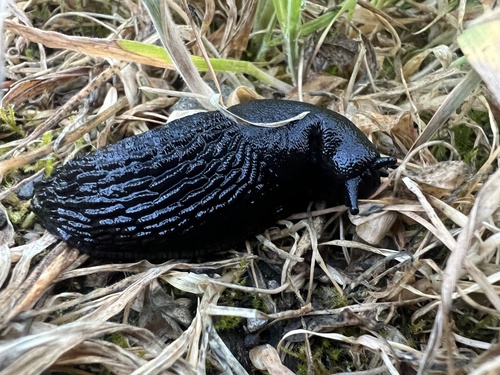
Black Slug
Arion ater
The undisputed titan of the garden floor, the Black Slug is a master of moisture and a crucial, if misunderstood, member of the decomposition squad. Known for its massive size and glossy, jet-black appearance, this nocturnal gastropod is a fascinating subject for any backyard observer.
Quick Identification
Size
10-15 cm (4-6 inches) in length, though can reach up to 20 cm (8 inches) when fully extended while crawling.
Colors
Usually jet black, but can appear in shades of brown, orange, or greenish-grey; the foot fringe often features subtle orange or yellow transverse stripes.
Key Features
- Large, bulky body without an external shell
- Round back when resting, lacking a dorsal keel
- Contracted 'hunch' or bell-shaped posture when threatened
- Coarse, wrinkled skin texture
- Respiratory pore (pneumostome) located on the right side of the mantle.
When You’ll See Them
Geographic range
Where Does the Black Slug Live?
Native to the cool and temperate regions of Western and Northern Europe, the Black Slug is a ubiquitous sight from the British Isles and Scandinavia down through Germany and France. Due to its hardy nature, it has been introduced to various parts of the world, most notably establishing significant populations in North America, particularly along the Pacific Northwest coast and Atlantic Canada. It thrives in maritime climates where humidity is high and winters are relatively mild, often becoming the dominant slug species in these introduced territories.
Basemap © OpenStreetMap contributors
Behavior
The Black Slug is a primarily nocturnal creature, highly dependent on moisture to prevent its soft body from drying out. During the day, it typically seeks refuge under logs, stones, or deep within garden litter. One of its most distinctive behaviors occurs when it feels threatened: instead of retreating into a shell, it contracts its body into a tough, hemispherical ball and often rhythmically sways from side to side to deter predators.
As hermaphrodites, these slugs possess both male and female reproductive organs, though they usually seek a mate for cross-fertilization. Their movement is powered by a muscular 'foot' that secretes a layer of thick mucus, which not only facilitates gliding but also serves as a chemical trail for other slugs to follow. In garden settings, they are often solitary foragers but may congregate in high numbers around particularly rich food sources like compost heaps.
EverydayEarth exclusive
Camera Tips
Capturing a Black Slug on camera requires a shift in strategy compared to filming birds or mammals. Because slugs are cold-blooded and move slowly, traditional PIR (Passive Infrared) motion sensors on trail cameras often fail to trigger. To successfully document them, use 'Time-Lapse Mode' set to intervals of 30 seconds to 1 minute. This ensures you catch their slow progression across the frame and creates a fascinating video effect as they glide and extend their tentacles.
Placement is everything—your camera must be at ground level. Prop your camera up with a small block or use a low-profile stake to aim the lens slightly downward towards a damp, flat surface. For the best results, use a camera with a close-focus or macro lens capability, as standard trail cams may have a minimum focus distance of 3 to 5 feet, which is too far for such a small subject. Aim for a focus distance of 12-18 inches if possible.
To guarantee a visit, you can use a harmless attractant. A shallow dish of beer (a 'beer trap' setup) or a few slices of overripe melon or cucumber will bring them into the frame within hours of nightfall. If your camera has adjustable LEDs, use the 'Low Glow' or 'No Glow' setting to prevent overexposing the slug's glossy, reflective skin, which can easily turn into a white blob in night shots. Positioning the camera near a known 'slime trail' on a garden path is a surefire way to catch them in transit.
Similar Species
Species that look similar or are commonly confused with Black Slug.
Frequently Asked Questions
Record Black Slug at your habitat
Connect a camera to start building your own species record — AI identifies every visitor automatically.