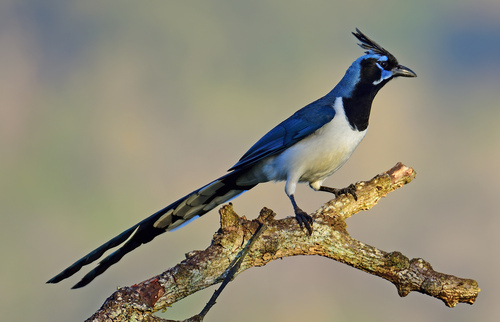
Black-throated Magpie-Jay
Cyanocorax colliei
With a tail longer than its body and a striking jet-black crest, the Black-throated Magpie-Jay is the undisputed royalty of the Mexican forest edge. These intelligent, social birds bring a splash of brilliant blue and a chorus of complex calls to any backyard they visit.
Quick Identification
Size
58–77 cm (23–30 in) long; 225–250 g (8–8.8 oz); tail accounts for more than half of total length
Colors
Brilliant blue upperparts, white underparts, black face and throat with a long black crest; blue tail with white outer tips
Key Features
- Extraordinarily long, graduated tail with white tips
- Tall, forward-curving black crest of feathers
- Large black throat and chest patch
- Deep blue upperparts and white underparts
When You’ll See Them
Geographic range
Where Does the Black-throated Magpie-Jay Live?
Native to the North American continent, the Black-throated Magpie-Jay is a signature species of northwestern Mexico. Its core range extends along the Pacific slope from southern Sonora through Sinaloa and Nayarit to northern Jalisco. While they are primarily restricted to these Mexican coastal regions, they are occasionally found as rare visitors or established escapees in parts of the southwestern United States.
Basemap © OpenStreetMap contributors
Behavior
Black-throated Magpie-Jays are highly social and intelligent corvids that typically travel in family groups of 5 to 20 individuals. These groups are often led by a dominant breeding pair and supported by helpers, usually offspring from previous years, who assist in defending the territory and feeding the young. They are incredibly vocal birds, possessing a wide repertoire of raucous calls, whistles, and even mimics of other bird species.
In the wild, they are bold and inquisitive, often following larger mammals to catch insects stirred up by their movement. When interacting with humans, they can become quite habituated to presence, especially in gardens or parks where food is available. Their high intelligence makes them quick to learn the schedules of backyard bird feeders, often appearing at the same time each day for a meal.
EverydayEarth exclusive
Camera Tips
Capturing the Black-throated Magpie-Jay requires careful consideration of their immense tail. Mount your camera at a height of 5 to 7 feet, but ensure the lens is positioned at least 8 to 10 feet away from your feeder or perching area. If the camera is too close, the bird's long tail will frequently be cut off, or the motion sensor may trigger too late to catch the head and body. A wide-angle lens setting is highly recommended.
Because these birds are extremely fast and social, set your camera to 'Burst Mode' or high-frame-rate video. They rarely travel alone, so a 15-second video clip is often better than a single photo, as it will likely capture several family members following the leader. To get the best color out of their brilliant blue feathers, place the camera facing north or south to avoid the harsh, direct morning or evening sun which can blow out the white underparts and cause glare on the blue plumage.
Attracting them to your camera's field of view is best done with a large, open platform feeder. They struggle with small, hanging tube feeders due to their size. Offer whole unsalted peanuts, sunflower seeds, or chunks of fruit like melon and papaya. Providing a sturdy, elevated birdbath is another excellent strategy; these jays love to bathe, and the sight of them managing their long tail feathers in the water makes for some of the most entertaining footage you can capture.
Similar Species
Species that look similar or are commonly confused with Black-throated Magpie-Jay.
Frequently Asked Questions
Record Black-throated Magpie-Jay at your habitat
Connect a camera to start building your own species record — AI identifies every visitor automatically.