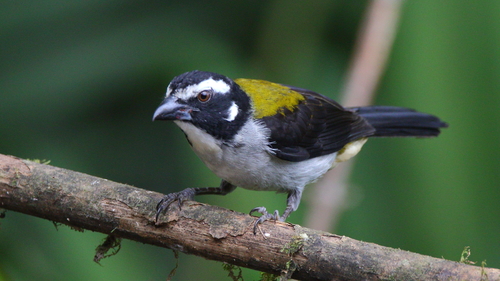
Black-winged Saltator
Saltator atripennis
A striking inhabitant of the Andean mist, the Black-winged Saltator stands out with its high-contrast plumage and melodic song. This resident of Colombia and Ecuador is a frequent visitor to high-altitude gardens where fruit is plentiful.
Quick Identification
Size
21-22 cm (8.3-8.7 inches) in length; weighs approximately 45-55 grams (1.6-1.9 oz)
Colors
Olive-green upperparts with jet-black wings and tail; white throat with black malar stripes and a prominent white eyebrow (supercilium)
Key Features
- Solid black wings and tail contrasting with olive back
- Broad white eyebrow stripe reaching behind the eye
- White throat bordered by thick black 'mustache' stripes
- Heavy, thick-based black bill characteristic of saltators
When You’ll See Them
Geographic range
Where Does the Black-winged Saltator Live?
This bird is a specialty of the northern Andes in South America. It is natively found across the Western and Central Andes of Colombia and continues through the lush mountain slopes of northwestern Ecuador. Because it thrives in humid, high-altitude environments, it is rarely seen in the lowlands, maintaining a core range in the misty 'tierra fría' and 'tierra templada' zones.
Basemap © OpenStreetMap contributors
Behavior
The Black-winged Saltator is a methodical and vocal inhabitant of the Andean cloud forests. While they can be somewhat secretive in dense foliage, they are frequently revealed by their loud, musical song—a series of clear, ringing whistles that echo through the mountain mist. Unlike some smaller tanagers that dart frantically, the saltator moves with a more deliberate, heavy-bodied hopping motion through the mid-story and canopy.
These birds are social but not overly gregarious. They are often seen in pairs or small family groups, and they frequently join mixed-species foraging flocks. Within these groups, they act as stable members, following the 'leaders' like woodcreepers or flowerpiercers to find active insect patches or newly ripened fruit trees. In gardens and forest edges, they are curious but remain alert, quickly retreating to thick cover if disturbed.
EverydayEarth exclusive
Camera Tips
To capture the Black-winged Saltator on a backyard camera, you must focus on 'staging areas' near forest edges. These birds prefer to move through thick cover, so placing your camera near a dense hedge or a native fruiting tree like a Miconia is ideal. Set the camera at a height of 5 to 7 feet, as they rarely feed on the ground, preferring to stay at eye-level or higher. A wide-angle lens is helpful if you are mounting the camera close to a specific branch where they like to perch and sing.
Baiting is highly effective for this species. A platform feeder stocked with halved papayas, bananas, or overripe plantains will almost certainly attract them if they are in the area. Because they are larger and heavier than many other tanagers, ensure your feeder is stable and doesn't swing wildly, which can spook them or lead to blurry footage. Setting your camera to a fast trigger speed (0.3 seconds or less) is vital, as they often take a quick bite and then hop back into the shadows.
Given their high-altitude habitat, moisture is your biggest enemy. Cloud forest environments are prone to heavy fog and condensation. Use a camera housing with a small 'eave' or hood to keep the lens dry, and always include a fresh silica desiccant pack inside the battery compartment to prevent internal fogging. The best footage is usually captured in the early morning when the birds are most active; consider setting your camera to record 15-second video clips to capture their unique 'tail-flicking' behavior and vocalizations.
Similar Species
Species that look similar or are commonly confused with Black-winged Saltator.
Frequently Asked Questions
Record Black-winged Saltator at your habitat
Connect a camera to start building your own species record — AI identifies every visitor automatically.