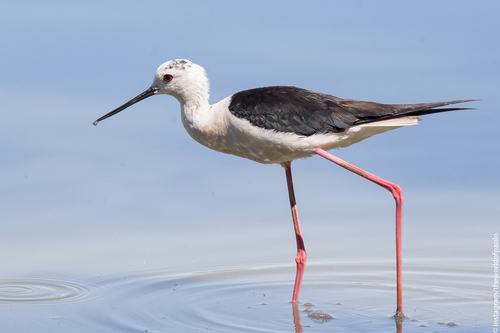
Black-winged Stilt
Himantopus himantopus
Meet the supermodel of the marshes, a bird defined by its impossibly long pink legs and striking monochromatic plumage. The Black-winged Stilt is a master of the shallows, turning every wetland into a high-fashion runway.
Quick Identification
Size
Length: 33–40 cm (13–16 in); Wingspan: 67–83 cm (26–33 in); Weight: 140–205 g (4.9–7.2 oz)
Colors
Striking white head and underparts with contrasting jet-black wings and back. Legs are a vivid bubblegum pink or reddish-pink.
Key Features
- Exceptionally long, slender pink legs
- Fine, straight, needle-like black bill
- High-contrast black and white plumage
- Elegant, slender neck and long wings
When You’ll See Them
Geographic range
Where Does the Black-winged Stilt Live?
This elegant wader is native across a vast territory spanning southern and central Europe, most of Africa, and large portions of Asia including India and Southeast Asia. While many populations in warmer climates are resident year-round, those breeding in more temperate northern regions are migratory, traveling to tropical latitudes to escape the winter frost. They are highly adaptable and often appear in new wetland areas shortly after seasonal rains flood the landscape.
Basemap © OpenStreetMap contributors
Behavior
The Black-winged Stilt is an exceptionally social bird, often found in small, loose groups or large colonies, especially when nesting. They are famous for their grace while wading through shallow water, using their disproportionately long legs to reach depths that other shorebirds cannot access. Despite their delicate appearance, they are bold and highly vocal, known for their persistent, piping 'yip-yip-yip' alarm calls that they use to mob predators or warn the colony of intruders.
During the breeding season, they exhibit fascinating territorial displays and are fiercely protective of their nests, which are often just simple scrapes on the ground near the water's edge. In flight, they are unmistakable, with their long pink legs trailing far behind their tail. While they can be wary of human approach, they are increasingly common in man-made habitats like rice paddies and salt works, where they have learned to coexist with low-intensity human activity.
EverydayEarth exclusive
Camera Tips
To capture the best footage of Black-winged Stilts, camera placement is everything. You should position your camera at a very low angle, ideally just a few inches above the waterline on a tripod or a specialized ground mount. This 'frog’s-eye view' emphasizes the bird's incredible leg length and creates a beautiful bokeh effect with the water in the background. Aim your lens at shallow mudflats or the transition zone between water and shore, as this is where they spend the majority of their time foraging.
Because stilts are visual hunters, they aren't attracted to traditional birdseed or suet. If you have a backyard pond or water feature, you can attract them by maintaining a wide, flat muddy edge free of tall vegetation, which provides them with the clear sightlines they need to feel safe from predators. Ensure your camera is facing away from the sun to avoid blowing out their bright white feathers, or use the 'Golden Hour' light of early morning and late afternoon to give their pink legs an extra glow.
Set your camera to a fast trigger speed and high-sensitivity PIR setting. Stilts are fast movers when they strike at prey, so a burst mode or high-frame-rate video (60fps if available) is essential for capturing the sharp action of a hunt. If your AI camera supports 'Region of Interest' triggering, focus the detection zone on the water's edge. Lastly, since these birds are social, leave your camera running for a few minutes after the first bird appears; they often travel in pairs or small family units, and the best interactions usually happen when the whole group arrives.
Similar Species
Species that look similar or are commonly confused with Black-winged Stilt.
Frequently Asked Questions
Record Black-winged Stilt at your habitat
Connect a camera to start building your own species record — AI identifies every visitor automatically.