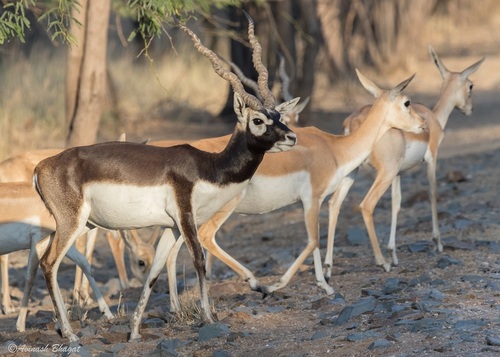
Blackbuck
Antilope cervicapra
With its magnificent corkscrew horns and striking tuxedo-like coat, the Blackbuck is the undisputed elegant sprinter of the open plains. Witness one of the fastest land animals in the world as it leaps with effortless grace across the grasslands.
Quick Identification
Size
Shoulder height 74–84 cm (29–33 in); Weight 20–57 kg (44–126 lb)
Colors
Males are dark brown to black with white bellies and eye rings; females/juveniles are yellowish-fawn with a prominent white side-stripe.
Key Features
- Long spiraling corkscrew horns (males)
- Striking white 'spectacles' around the eyes
- High-contrast black and white coat (mature males)
- Slender, athletic build with thin legs
When You’ll See Them
Geographic range
Where Does the Blackbuck Live?
Native to the Indian subcontinent, the Blackbuck is most commonly found across the plains of India and Nepal. While their numbers declined sharply in the 20th century, they have seen a resurgence in protected parks and community-managed lands. Beyond Asia, thriving introduced populations exist in the United States—specifically the Texas Hill Country—and across parts of Argentina, where they have adapted perfectly to the local savanna-like environments.
Basemap © OpenStreetMap contributors
Behavior
Blackbucks are highly social and diurnal animals, meaning they are most active during the daylight hours. They are famous for 'pronking'—high, stiff-legged leaps into the air that signal to predators that they are fit and difficult to catch. They typically live in herds of 15 to 50 individuals, usually led by a dominant territorial male who defends his harem from rivals.
These antelopes are incredibly fast, capable of reaching speeds up to 80 km/h (50 mph), making them one of the fastest land animals in the world. While they are naturally shy of humans, they have adapted to living near agricultural areas where they graze on crops, often retreating to the safety of tall grass or scrubland when disturbed.
EverydayEarth exclusive
Camera Tips
To capture the best footage of Blackbucks, focus your camera placement on the edges of open meadows or near permanent watering holes. Because these antelopes are shorter than many deer species, mount your camera approximately 24 to 30 inches (60-75 cm) off the ground. An upward angle can make the male's corkscrew horns look even more impressive, but a level mount is best for capturing the distinctive white 'spectacle' markings around their eyes.
Since Blackbucks are extremely fast and 'twitchy,' use a camera with a fast trigger speed (0.3 seconds or less) to avoid capturing just the tail end of the animal. Setting your camera to a 3-shot burst mode is highly recommended; this increases your chances of catching their iconic leaping behavior or the territorial displays of males. High-resolution video is also excellent for observing their social interactions, such as the 'head-up' threat posture used by dominant males.
In North American or South American ranch settings, Blackbucks are often attracted to salt licks or protein feeders. If you are monitoring a wild population, look for 'leks'—open areas where males congregate to display for females. You can identify these spots by patches of heavily trampled grass and concentrated dung piles. During the rutting seasons in early spring and autumn, these areas become hubs of activity, providing the best opportunity to record sparring matches between rival males.
Similar Species
Species that look similar or are commonly confused with Blackbuck.
Frequently Asked Questions
Record Blackbuck at your habitat
Connect a camera to start building your own species record — AI identifies every visitor automatically.