Springbok
Antidorcas marsupialis
The high-jumping acrobat of the African savanna. With their striking markings and incredible speed, the Springbok is the ultimate prize for any backyard explorer in Southern Africa.
Quick Identification
Size
71-86 cm (28-34 in) at the shoulder; weighs 27-42 kg (60-93 lbs)
Colors
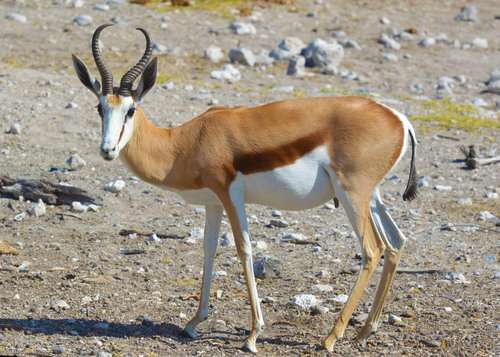
Fawn-colored upper body with a dark reddish-brown lateral stripe; white underbelly and white face with dark 'tear' stripes.
Key Features
- Lyrate black horns curved backwards
- Distinctive dark reddish-brown stripe on flanks
- White face with dark stripes from eyes to mouth
- White rump flap used for 'pronking' displays
When You’ll See Them
Behavior
Springbok are world-famous for their unique 'pronking' behavior—a series of high, stiff-legged leaps into the air with an arched back. This spectacular display, which can reach heights of 2 meters (6.5 feet), is used to signal health and strength to predators or to show excitement within the herd. They are highly social animals, often forming small bachelor groups or larger nurseries of females and young.
These antelopes are remarkably hardy and have adapted to survive in some of the harshest environments in Southern Africa. They are incredibly fast, capable of reaching speeds up to 88 km/h (55 mph), making them one of the fastest land mammals on Earth. While they are wild by nature, they are frequently found on private conservancies and large rural estates, where they may become somewhat habituated to the distant presence of humans.
EverydayEarth exclusive
Camera Tips
When setting up a camera for Springbok, height and field of view are your most critical factors. Position your camera approximately 3 to 4 feet (1 meter) off the ground to capture their full profile. Because Springbok are often on the move and prone to sudden leaps, a wider field of view is better than a tight zoom. If your camera is placed too close to a trail, you risk capturing only a blur of legs or a mid-body shot as they sprint past.
To capture the iconic 'pronk,' you must prioritize trigger speed and burst mode. Look for a camera with a trigger speed of 0.3 seconds or faster. Enable a 3-to-5-photo burst setting; this significantly increases your chances of catching a Springbok in mid-air. Since they are most active during the low-light hours of dawn and dusk, ensure your camera has a high-quality infrared flash that won't spook them but provides enough clarity to see their distinctive facial markings.
Placement should focus on open clearings or edges of shrubland. If you live on a large property or game farm, water sources are the ultimate magnet, especially during the dry season. A camera angled toward a water trough or a natural mineral lick will produce the most consistent results. To avoid 'white-out' from the harsh African sun, always face your camera North or South. This ensures the morning and evening light hits the side of the animal rather than shining directly into the lens.
Lastly, pay attention to the wind and concealment. Springbok have an incredible sense of smell and sharp eyesight. While they aren't as elusive as leopards, a poorly hidden camera that smells like human scent may cause them to skirt the area. Use gloves when handling the camera and try to mask it with local vegetation without obstructing the PIR sensor. If you use video, set the clip length to at least 15-20 seconds to witness the social interactions within the herd.
Similar Species
Species that look similar or are commonly confused with Springbok.
Frequently Asked Questions
Record Springbok at your habitat
Connect a camera to start building your own species record — AI identifies every visitor automatically.