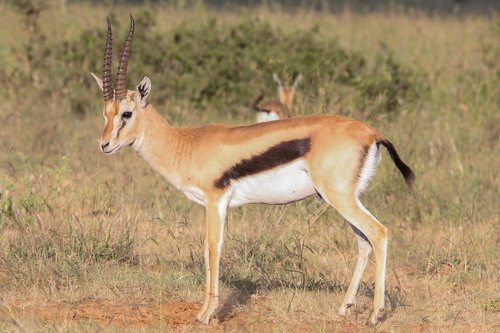
Thomson's Gazelle
Eudorcas thomsonii
The Thomson's Gazelle is the iconic sprinter of the African plains, easily recognized by its bold black side-stripe and incredible jumping ability. These social grazers are a masterclass in agility and alertness.
Quick Identification
Size
Height at shoulder 22-32 in (55-82 cm); weight 33-77 lb (15-35 kg); length 31-47 in (80-120 cm)
Colors
Tawny or light brown upper body with a bright white underbelly; distinguished by a bold, thick black stripe running along the side. Both sexes have ringed, S-shaped horns, though males' are larger and thicker.
Key Features
- Bold black horizontal stripe separating brown back from white belly
- Ringed, backward-curving horns
- White rump patch bordered by black
- Frequent, rapid tail twitching
When You’ll See Them
Behavior
Thomson's Gazelles, affectionately known as 'tommies,' are highly social and energetic animals. They are famous for a behavior called 'stotting' or 'pronking,' where they spring high into the air with all four legs stiff and their back arched. This isn't just for show; it's a signal to predators like cheetahs that the gazelle is fit, alert, and will be difficult to catch, often discouraging a chase before it even begins.
These gazelles are migratory and travel in herds that can range from a dozen to hundreds of individuals. They often associate with wildebeest and zebras during the Great Migration, benefitting from the protection of a larger group. In their social hierarchy, males are territorial and use scent glands near their eyes to mark blades of grass, while females and young move through these territories in search of the best grazing spots.
EverydayEarth exclusive
Camera Tips
When setting up a camera to capture Thomson's Gazelles, focus on wide-open areas with high visibility. Because these animals avoid tall vegetation to stay clear of predators, your camera should be positioned on the edge of a clearing or near a well-traveled game trail. To get the most intimate footage, mount your camera at a 'gazelle-eye' level—roughly 2 to 3 feet off the ground. This angle captures the distinctive facial markings and the bold black flank stripe much more effectively than a downward-facing mount.
Trigger speed is your biggest challenge with this species. Tommies are incredibly fast and can reach speeds of over 50 mph. Use a camera with a sub-0.3 second trigger speed to avoid getting 'ghost' images or photos of just a disappearing tail. If your camera supports it, 'Burst Mode' or 'Multi-Shot' is highly recommended; catching a gazelle mid-stot is the holy grail of backyard savanna photography, and you'll need multiple frames to ensure one is perfectly timed.
Water is the ultimate lure for Thomson's Gazelles. While they can get some moisture from the grass they eat, they prefer to drink daily. Placing a camera near a watering hole during the dry season will yield the highest volume of captures. Since they are strictly diurnal, you don't need to worry much about infrared flash range, but ensure your camera is positioned with the sun at its back (facing North or South) to prevent the harsh equatorial sun from washing out the white sections of their coat.
Lastly, consider the season. During the rainy season, herds are more dispersed. During the dry season, they congregate around permanent water sources and 'lawns' of short grass. If you are using a camera in a fixed location, check for signs of fresh dung middens—males use these to mark their territory, and they will return to the same spot repeatedly, making it a prime location for a consistent camera setup.
Similar Species
Species that look similar or are commonly confused with Thomson's Gazelle.
Grant's Gazelle
Larger in size; the white patch on its rump extends above the base of the tail onto the back.
Impala
Lacks the black side stripe and has a characteristic black 'M' shape on its rear.
Red-fronted Gazelle
Very similar but found in the Sahel region; it has a much thinner and lighter side stripe.
Frequently Asked Questions
Record Thomson's Gazelle at your habitat
Connect a camera to start building your own species record — AI identifies every visitor automatically.