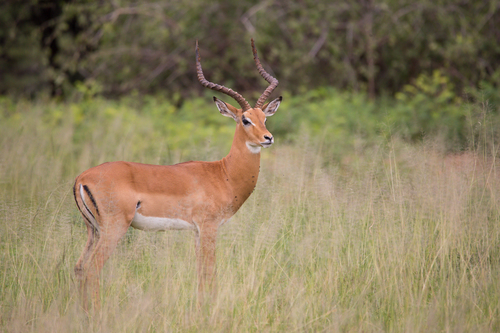
Impala
Aepyceros melampus
The impala is the ultimate savanna acrobat, famous for its gravity-defying leaps and elegant lyre-shaped horns. A master of adaptation, this social antelope thrives where grass and woodland meet.
Quick Identification
Size
Shoulder height: 70–92 cm (28–36 in); Weight: 40–65 kg (88–143 lb)
Colors
Glossy reddish-brown coat with tan flanks and a white underbelly; distinctive black vertical stripes on the tail and thighs.
Key Features
- Slender, lyre-shaped horns on males up to 92 cm long
- Black 'M' marking on the rump
- Scent glands covered by tufts of black hair on the back of the hind legs
- Large, alert ears and dark, liquid eyes
When You’ll See Them
Sightings on EverydayEarth
Aug 2, 2026
A male Impala stands alert in the dry savanna landscape, positioned near a thicket of shrubs. It remains mostly stationary, turning its head to scan the environment for potential threats or other herd members.
Aug 1, 2026
A group of Waterbuck are wading and standing in a shallow waterhole covered in lily pads. They appear relaxed, with some looking toward the camera. In the background on the dry, grassy bank, an Impala stands still, surveying the area.
Aug 1, 2026
A small flock of Helmeted Guineafowl is actively foraging in the dry grass at the center of the clearing. On the far left, an Impala is partially obscured as it grazes in the shade of a large bush.
Aug 1, 2026
A large herd of Impala is spread across the foreground and mid-ground of a grassy field near a waterhole. The animals are actively grazing, with several males displaying their characteristic lyre-shaped horns while moving through the group.
Aug 1, 2026
A diverse group of animals has gathered at the waterhole under the bright morning sun. Several Common Wildebeest are wading and drinking in the shallow water, while a single Impala stands nearby. In the background, an African Savanna Elephant can be seen near the far left shore, and a small herd of Plains Zebras is gathered on the grassy bank to the right.
Aug 1, 2026
An adult male impala stands at the edge of a thicket, browsing on the leaves of a bush. It remains mostly stationary, focused on feeding in the bright morning light.
Geographic range
Where Does the Impala Live?
The impala is a quintessential resident of Eastern and Southern Africa, spanning a wide arc from Kenya and Uganda down through Tanzania, Zambia, and into South Africa. They are incredibly common in core conservation areas like the Serengeti and the Kruger National Park, though the unique black-faced subspecies is restricted to the arid border regions of Namibia and Angola. Unlike many migratory species, impala are generally sedentary, remaining in the same general territory as long as water is available.
Basemap © OpenStreetMap contributors
Recorded on EverydayEarth
Behavior
Impala are highly social animals that live in organized herds. Their social structure changes with the seasons; during the wet months, dominant males defend large territories to secure breeding rights with female herds, while other males form bachelor groups. During the dry season, these groups often merge into massive aggregate herds to better locate dwindling food and water sources.
Known as the 'athletes of the savanna,' impala are famous for their incredible leaping ability. When startled, they can leap over 3 meters (10 feet) into the air and cover distances of 10 meters (33 feet) in a single bound. This behavior, known as 'stotting' or 'pronking,' is thought to confuse predators like lions, leopards, and wild dogs while signaling the impala's high fitness level.
EverydayEarth exclusive
Camera Tips
To capture high-quality footage of impala, position your camera near a permanent water source or a well-used game trail. Impala are water-dependent and usually drink at least once a day, typically during the heat of the afternoon when predators are less active. Set your camera at a height of approximately 1 meter (3-4 feet) to ensure you capture the full body profile, including the distinctive black markings on their hind legs and the impressive horns of the males.
Because impala are incredibly fast and prone to sudden, explosive movements, a camera with a fast trigger speed (0.3 seconds or faster) is essential. If you are using video mode, set a high frame rate to capture their graceful leaps without motion blur. Impala are also very vocal; setting your camera to record audio can help you capture the loud, snorting 'alarms' they give when they sense a predator nearby.
During the rutting season, which usually peaks around May, look for open 'leks' or clearings where males engage in territorial displays. This is the best time to capture dramatic social interactions, including horn-clashing and 'roaring' displays. Using a 'no-glow' or 'black' infrared flash is recommended, as these antelopes are highly alert and may be spooked by the faint red glow of standard IR LEDs, potentially ruining the natural behavior you want to document.
Similar Species
Species that look similar or are commonly confused with Impala.
Frequently Asked Questions
Record Impala at your habitat
Connect a camera to start building your own species record — AI identifies every visitor automatically.