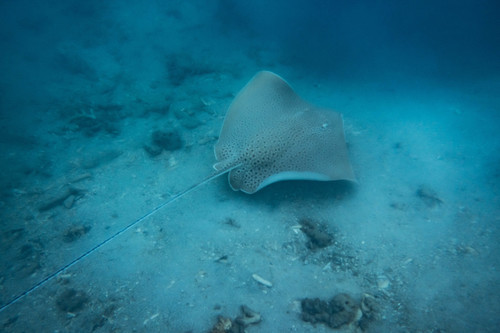
Blackspotted Whipray
Maculabatis astra
The Blackspotted Whipray is a living work of art, featuring a celestial pattern of dark speckles and a striking banded tail. A common but elusive resident of Australia's northern shallows, it glides through the sand like a ghost of the seafloor.
Quick Identification
Size
Disc width up to 80 cm (31 in); total length including the whip-like tail can reach 1.5–1.8 metres (5–6 feet).
Colors
Grayish-brown to tan dorsal surface covered in small, dense dark spots; tail features alternating light and dark 'saddle' bands behind the sting.
Key Features
- Angular, diamond-shaped pectoral disc
- Whip-like tail significantly longer than the body
- Extensive pattern of small dark spots across the back
- Alternating light and dark bands on the tail
- Absence of fin folds on the tail
When You’ll See Them
Geographic range
Where Does the Blackspotted Whipray Live?
The Blackspotted Whipray is a tropical specialist native to the coastal waters of the Indo-Pacific, specifically concentrated around northern Australia and southern New Guinea. Its core range extends from the Shark Bay region in Western Australia, across the Top End, and down through the Great Barrier Reef in Queensland. It is also commonly found in the Arafura Sea and the shallow shelf waters surrounding southern Papua New Guinea and parts of Indonesia.
Basemap © OpenStreetMap contributors
Behavior
The Blackspotted Whipray is a sophisticated bottom-dweller that spends much of its life blending into the seafloor. It is a master of crypsis, using its pectoral fins to flap sand over its back until only its eyes and spiracles are visible. This allows the ray to remain hidden from predators like hammerhead sharks while waiting for unsuspecting prey to wander near. Because it lives on the bottom, it breathes through specialized openings called spiracles located behind the eyes, which pump oxygenated water over the gills even when the mouth is buried in silt.
This species is generally solitary and exhibits a calm temperament, though it is highly sensitive to vibrations in the water. They are most active during the shifting of the tides, particularly on the rising tide when they move into shallow flats to forage in newly submerged areas. While they possess a venomous spine for self-defense, they are not aggressive and will typically choose flight over fight if they sense a human approaching in the water.
EverydayEarth exclusive
Camera Tips
Capturing a Blackspotted Whipray requires a different strategy than terrestrial wildlife because standard PIR motion sensors on trail cameras cannot 'see' heat signatures through water. To successfully document this species, use a waterproof action camera with a high-capacity memory card. Set the camera to 'Time Lapse' mode, taking a photo every 5 to 10 seconds. This is the most reliable way to capture a ray as it glides through the frame in a marine environment.
For the best results, mount your camera on a weighted tripod or a low-profile diving weight and place it in shallow sandy flats or near the edges of seagrass beds during low tide. As the tide comes in, the rays will follow the water into these areas to hunt. Position the camera at a slight upward angle, roughly 15-20 degrees from the sea floor, to ensure you capture the full silhouette and the distinctive spotted pattern of the ray as it passes by.
If you are setting up near a pier or dock, you can submerge a camera on a pole, but ensure it is stabilized against the current. Avoid using bright artificial lights during the day, as they can create harsh reflections on the sand. At night, a diffused red light or a wide-beam underwater video light can help illuminate the ray's spots without startling it. Look for 'feeding pits' in the sand—circular depressions where rays have sucked up prey—as these are prime spots to station your camera for repeat visitors.
Similar Species
Species that look similar or are commonly confused with Blackspotted Whipray.
Frequently Asked Questions
Record Blackspotted Whipray at your habitat
Connect a camera to start building your own species record — AI identifies every visitor automatically.