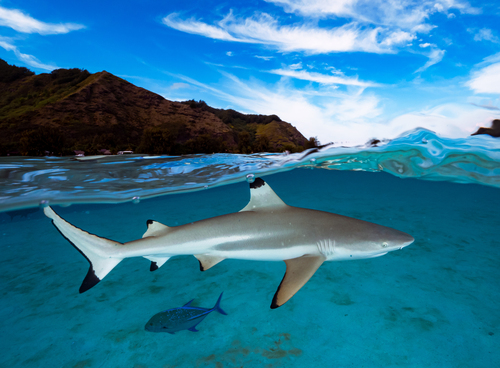
Blacktip Reef Shark
Carcharhinus melanopterus
With its iconic black-tipped fins and graceful silhouette, this reef patroller is the most recognizable shark of the tropical shallows.
Quick Identification
Size
Typically 1.2 to 1.6 m (3.9 to 5.2 ft) in length; weighs between 13 and 45 kg (30 to 100 lbs).
Colors
Yellow-brown to brownish-gray upper body with a crisp white underbelly; distinctive black tips on all fins, highlighted by a pale band below the dorsal tip.
Key Features
- Prominent black tip on the first dorsal fin with a light band below it
- Sleek, torpedo-shaped body with a short, rounded snout
- Second dorsal fin is relatively large and also black-tipped
When You’ll See Them
Geographic range
Where Does the Blacktip Reef Shark Live?
The Blacktip Reef Shark is a quintessential inhabitant of the tropical Indo-Pacific region. Its native waters stretch from the Red Sea and the coast of East Africa across the Indian Ocean to the vast archipelagos of Southeast Asia and the northern coasts of Australia. They are also widely distributed across the Central Pacific, appearing around remote islands and atolls such as those in Hawaii and French Polynesia, where they remain year-round residents of the reef systems.
Basemap © OpenStreetMap contributors
Behavior
The Blacktip Reef Shark is a highly social and inquisitive species, often found in small groups patrolling the shallowest sections of coral reefs. Unlike many larger shark species, they are quite timid and easily spooked by sudden movements or loud noises in the water. They exhibit a strong preference for a limited home range, often staying within the same reef system for years, which makes them a reliable subject for local observation.
While they are active during the day, their hunting intensity often increases during the changing of the tides. They are known for a cooperative hunting style where multiple individuals may herd schools of small fish into shallow water to strike. Interactions with humans are generally peaceful, as they are not aggressive unless provoked or lured with food, though their presence in extremely shallow water can lead to startling encounters for waders.
EverydayEarth exclusive
Camera Tips
Capturing the Blacktip Reef Shark requires a specialized approach compared to land animals. If you have a property overlooking a reef or a dock in a tropical lagoon, a fixed underwater camera or an 'action cam' mounted on a weighted PVC rig is ideal. Position your camera in the 'intertidal zone'—the area where the water is deep enough to stay submerged at low tide but shallow enough to receive plenty of natural sunlight. Aim the lens horizontally across a sandy patch adjacent to a coral head, as sharks use these open 'lanes' for cruising.
Natural lighting is your best friend. Since these sharks are often in very shallow water, the sun creates beautiful dancing light patterns (caustics) on their backs. For the best clarity, set your camera to record at a high frame rate (60fps or higher) to capture their fluid, snake-like swimming motion. If you are filming from a dock looking down, use a circular polarizing filter to cut through the surface reflection and reveal the sharks patrolling below.
Timing is critical. These sharks are most active and come closest to shore during a rising tide, especially when it coincides with dawn or dusk. Avoid using artificial lights at night if possible, as the backscatter from sand particles can ruin the image; instead, rely on high-ISO settings or motion-activated underwater LEDs that have a soft diffusion. Ensure your housing is cleaned of algae weekly to prevent the 'green haze' effect on your footage.
Similar Species
Species that look similar or are commonly confused with Blacktip Reef Shark.
Frequently Asked Questions
Record Blacktip Reef Shark at your habitat
Connect a camera to start building your own species record — AI identifies every visitor automatically.