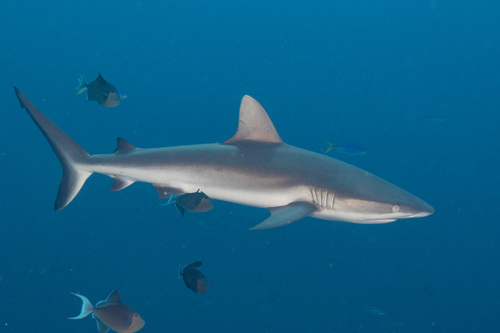
Grey Reef Shark
Carcharhinus amblyrhynchos
The Grey Reef Shark is the sleek, social sentinel of the Indo-Pacific reefs. Known for its distinct black-edged tail and sophisticated social life, this predator is a master of the coral drop-off.
Quick Identification
Size
Typically 1.3 to 1.88 meters (4.3 to 6.2 feet) in length; weights usually range from 20 to 30 kg (44 to 66 lbs).
Colors
Upper body is bronze-grey to dark grey, transitioning to a stark white underbelly. Distinctive black margin on the trailing edge of the tail.
Key Features
- Prominent thick black border on the trailing edge of the caudal fin
- Broad, rounded snout with large, circular eyes
- Lacks an interdorsal ridge between the first and second dorsal fins
- First dorsal fin is plain grey or tipped in white
When You’ll See Them
Geographic range
Where Does the Grey Reef Shark Live?
The Grey Reef Shark is a quintessential resident of the warm tropical waters across the Indo-Pacific region. Its native range is vast, stretching from the Red Sea and the eastern coast of Africa across the Indian Ocean to the archipelagos of Southeast Asia and Northern Australia. In the Pacific, they are a dominant presence near the islands of Micronesia, Melanesia, and Polynesia, reaching their easternmost limits around the isolated waters of Easter Island. Because they are reef-dependent, their populations are concentrated around high-quality coral structures and deep-water drop-offs.
Basemap © OpenStreetMap contributors
Behavior
The Grey Reef Shark is a highly social species, known for forming large daytime aggregations near coral reef drop-offs and passes. Unlike many shark species that are solitary, these sharks exhibit a complex social structure and extreme site fidelity, often returning to the exact same section of a reef for years at a time. They are often seen 'surfing' the currents at reef edges to conserve energy while waiting for prey.
This species is famous among divers for its dramatic threat display. When cornered or feeling threatened, a Grey Reef Shark will arch its back, drop its pectoral fins, and swim with an exaggerated lateral head-shaking motion. This is a clear warning to intruders to back away. While generally cautious around humans, they can become aggressive in the presence of food or if they feel their territory is being encroached upon.
EverydayEarth exclusive
Camera Tips
Capturing the Grey Reef Shark requires a specialized underwater setup, ideally an AI-powered camera in a waterproof housing rated for at least 40 meters. To get the best results, mount your camera near 'cleaning stations'—specific areas of the reef where smaller fish pick parasites off larger predators. These sharks visit these spots regularly and will often hover nearly motionless, allowing for high-detail captures. Aim for a camera height of 0.5 to 1 meter above the substrate, angled slightly upward to capture the shark's silhouette against the sunlight filtering from the surface.
Lighting is critical for identifying markings like the black tail margin. If you are filming during their peak activity hours at dawn or dusk, use dual external video lights with a wide beam angle (120 degrees or more) to avoid harsh shadows. Setting your camera to a higher frame rate, such as 60fps or 120fps, is recommended. These sharks move with a sleek, fluid motion that looks spectacular in slow motion and helps the AI identify the distinctive fin shapes that distinguish them from Blacktip Reef Sharks.
For a 'backyard' reef setup, you can attract them to the camera's field of view using a scent lure. A perforated PVC tube filled with minced fish (chum) can be secured to a nearby rock or coral (ensure you aren't damaging live coral). The scent will draw them in from the current, often leading to curious 'close-ups' as they investigate the source. Always check local regulations regarding shark feeding or baiting, as some marine protected areas prohibit these practices to maintain natural behavior.
Similar Species
Species that look similar or are commonly confused with Grey Reef Shark.
Blacktip Reef Shark
The Blacktip has a conspicuous black tip on its first dorsal fin, while the Grey Reef Shark's first dorsal is plain or white-tipped.
Whitetip Reef Shark
Much slenderer with clear white tips on both dorsal fins and the tail; often found resting on the sandy bottom, which Grey Reef Sharks rarely do.
Caribbean Reef Shark
Found in the Atlantic/Caribbean rather than the Indo-Pacific; grows larger and has a dusky-colored tail rather than a sharp black margin.
Frequently Asked Questions
Record Grey Reef Shark at your habitat
Connect a camera to start building your own species record — AI identifies every visitor automatically.