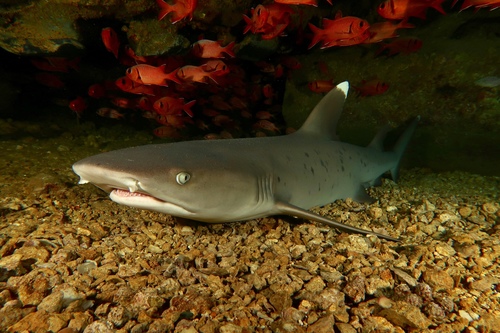
Whitetip Reef Shark
Triaenodon obesus
The ultimate reef insider, the Whitetip Reef Shark is a master of the coral labyrinth. Known for its peaceful daytime naps and high-energy midnight hunts, it is the most iconic resident of the Indo-Pacific shallows.
Quick Identification
Size
Typically reaches a length of 1.2 to 1.6 meters (4 to 5.2 feet) and weighs up to 18 kg (40 lbs).
Colors
Greyish-brown or bronze upper body with a pale, white underside; distinguished by stark white tips on the first dorsal fin and the upper lobe of the tail fin.
Key Features
- Slender, elongated body profile
- Prominent white tips on dorsal and caudal fins
- Broad, flat head with blunt snout and tubular nostrils
- Oval eyes with vertical pupils
When You’ll See Them
Behavior
The Whitetip Reef Shark is a fascinating social predator often found congregating in small groups within reef caves or on sandy patches during the day. Unlike many of its cousins in the requiem shark family, this species does not need to swim constantly to breathe; it can remain perfectly still on the seafloor, using its cheek muscles to pump oxygen-rich water over its gills. This sedentary daytime behavior makes them one of the most frequently observed sharks by divers and underwater camera enthusiasts.
When the sun sets, their personality shifts from sluggish to sleek. They are highly specialized nocturnal hunters, using their thin frames to navigate tight crevices and holes within the coral reef that other sharks simply cannot reach. They are generally unaggressive toward humans, though they are naturally curious and may approach cameras or divers to investigate their surroundings, especially if there is movement nearby.
EverydayEarth exclusive
Camera Tips
Capturing the Whitetip Reef Shark requires a specialized approach because of their aquatic environment and nocturnal lifestyle. For the best daytime shots, place your underwater trail camera or action cam near the entrance of known reef caves or under large coral overhangs. Look for sandy 'rest areas' where these sharks are known to group together during the day. Since they are stationary when resting, you can use a lower frame rate to save battery, but ensure your camera is securely weighted with a lead base or a heavy tripod to withstand surge and currents.
For nighttime action, position your camera near narrow 'corridors' in the reef. These sharks weave through the coral structure to flush out prey, often using the same paths repeatedly. Use an external underwater light source, preferably one with a red-light mode, as this is less likely to startle the shark or disrupt its hunting behavior. Standard white LEDs can sometimes cause 'backscatter' (reflecting off particles in the water), so angling your lights slightly away from the center of the lens can improve clarity.
Because seawater absorbs color and light rapidly, set your camera to a wide-angle view and keep it as close to the target area as possible—ideally within 1-2 meters. If your camera supports it, a slightly higher ISO setting is beneficial for capturing their sleek movement in the dark without excessive motion blur. Lastly, always check your housing's depth rating and ensure the O-rings are lubricated; a leaky seal is the quickest way to end a shark-spotting expedition.
Similar Species
Species that look similar or are commonly confused with Whitetip Reef Shark.
Grey Reef Shark
Lacks the white fin tips and has a much more robust, traditional 'shark' shape with a dark margin on the tail fin.
Silvertip Shark
Much larger and more aggressive, with silver-white edges on all fins rather than just blunt white tips on the dorsal and tail.
Blacktip Reef Shark
Easily distinguished by the prominent black markings on the tips of its fins, particularly the first dorsal fin.
Frequently Asked Questions
Record Whitetip Reef Shark at your habitat
Connect a camera to start building your own species record — AI identifies every visitor automatically.