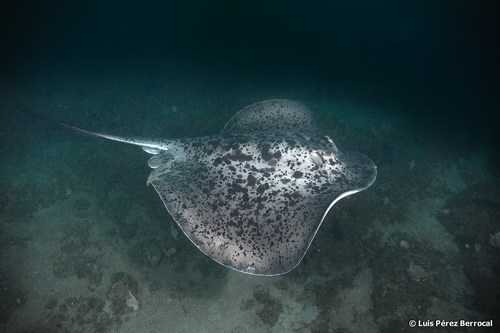
Blotched Fantail Ray
Taeniurops meyeni
Meet the ocean's decorated floor-dweller, a massive ray known for its striking 'camouflage' blotches and curious nature. A master of the reef, the Blotched Fantail Ray is a highlight for any coastal underwater observer.
Quick Identification
Size
Disc width up to 1.8 m (5.9 ft); total length up to 3.3 m (10.8 ft); weight up to 150 kg (330 lbs)
Colors
Upper disc is light grey to brownish with heavy black or dark grey mottling; the tail is solid black beyond the spine; the underside is creamy white.
Key Features
- Large, thick circular pectoral disc
- Distinctive black tail with a deep ventral fin fold
- Mottled or 'blotched' dark pattern on a lighter base
- Upper surface covered in small, prickly tubercles
When You’ll See Them
Geographic range
Where Does the Blotched Fantail Ray Live?
The Blotched Fantail Ray is a true citizen of the Indo-Pacific, spanning an enormous aquatic territory that stretches from the warm coastal waters of South Africa and the Red Sea across to southern Japan and the northern coast of Australia. This wide-ranging species is also frequently encountered around remote oceanic islands in the eastern Pacific, such as the Galápagos and Cocos Islands. While they are primarily residents of tropical reef systems, they are occasionally seen in subtropical regions depending on warm current patterns.
Basemap © OpenStreetMap contributors
Behavior
The Blotched Fantail Ray is a powerful and inquisitive predator often found patrolling the seafloor. Unlike many of its more skittish relatives, this species is known for its relative boldness around divers and underwater camera equipment. While they are capable of deep-sea travel, they spend much of their time in shallower lagoons or resting in the shelter of reef caves and ledges during the day.
These rays are primarily solitary but can be observed in small aggregations during mating periods or in areas with high food density. They are highly active at night, using their sensitive electroreception to locate prey buried beneath the sand. When threatened or stepped on, they can defend themselves with a venomous tail spine, but they generally prefer to glide away gracefully if given the space.
EverydayEarth exclusive
Camera Tips
Capturing a Blotched Fantail Ray requires a specialized underwater camera setup, such as a submersible trail camera or a tethered dock camera. To get the best results, mount your camera approximately 30 to 60 centimeters (1 to 2 feet) above the seabed, angled slightly downward. Look for 'corridors' where the reef meets the sand, as these are natural highways for rays searching for buried prey. If you are filming from a private dock or pier, a downward-facing camera with a wide-angle lens is essential to capture their massive 1.8-meter wingspan.
Because these rays are most active as hunters after dark, external lighting is a must. Use infrared (IR) illuminators if you want to observe natural behavior without startling the fish, though white light will better showcase their striking mottled patterns. Set your camera to record high-definition video rather than stills, as the fluid, undulating motion of the ray's disc is its most impressive feature. A trigger sensitivity set to 'High' is recommended, as the slow gliding motion can sometimes fail to trigger less sensitive sensors.
In coastal areas, tide cycles are your best friend. Plan your observation for the incoming high tide, which often brings these rays closer to shore and into shallower lagoons to feed. Be mindful of biofouling on the lens; in tropical waters, algae and barnacles can obscure the view within days. Using a specialized anti-fouling lens coating or performing weekly maintenance will ensure your footage remains crystal clear. If legal in your area, a small amount of fish offal placed in a perforated container (chumming) can act as a powerful lure to keep the ray in the camera's field of view for longer periods.
Similar Species
Species that look similar or are commonly confused with Blotched Fantail Ray.
Frequently Asked Questions
Record Blotched Fantail Ray at your habitat
Connect a camera to start building your own species record — AI identifies every visitor automatically.