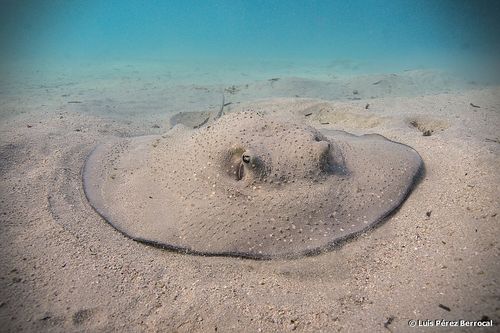
Porcupine Ray
Urogymnus asperrimus
The Porcupine Ray is the ocean’s armored tank, trading the traditional stingray barb for a spectacular coat of needle-sharp thorns. A rare find for any diver or coastal observer, this circular wonder is a master of the sandy shallows.
Quick Identification
Size
Disc width of 1.2–1.5 m (3.9–4.9 ft); total length can reach over 2 m (6.6 ft)
Colors
Uniform light to dark gray, brown, or purplish-brown on the upper disc; covered in distinctive white or pale sharp thorns and tubercles.
Key Features
- Nearly circular pectoral fin disc
- Densely covered in sharp, conical thorns
- Lacks a venomous stinging spine on the tail
- Thin, whip-like tail without any fin folds
When You’ll See Them
Behavior
The Porcupine Ray is a unique outlier among stingrays. While most of its relatives rely on a venomous barb for protection, this species has evolved a literal suit of armor. It is a slow-moving, bottom-dwelling specialist that spends much of its time cruising sandy flats or resting partially buried in the substrate. Despite its intimidating appearance, it is generally unaggressive, though its skin is so abrasive it can cause significant injury to anything—or anyone—that tries to handle it.
These rays are typically solitary and are known for their 'excavation' feeding style. They use their powerful pectoral fins to stir up the seabed, uncovering hidden prey. Because they lack a sting, they are often more approachable than other rays, but they rely on their incredibly tough, thorn-covered hide to deter large predators like hammerhead sharks. In areas with human activity, they may become accustomed to piers or docks where fish scraps are available, though they remain relatively rare and elusive across their range.
EverydayEarth exclusive
Camera Tips
Capturing a Porcupine Ray on camera requires a specialized underwater setup, particularly one capable of handling the high-glare environment of shallow sandy flats. If you are setting up a camera near a dock, pier, or reef edge, positioning is everything. Place your camera housing at a slight upward angle if it's on the seabed, or use a weighted tripod to keep it steady against the ebb and flow of the tide. Because these rays blend in perfectly with sandy bottoms, look for 'halos' or depressions in the sand—signs of recent feeding—and set your gear nearby.
Lighting is your best friend when trying to highlight the Porcupine Ray’s unique texture. In shallow water (less than 5 meters), natural sunlight provides the best results, but try to film during the mid-morning or early afternoon when the sun is directly overhead to minimize surface reflection. The sharp thorns that give this ray its name are its most photogenic feature; side-lighting from an underwater strobe or video light can create shadows that make the 'porcupine' texture pop against the flat disc of the body.
While we don't recommend traditional 'baiting' which can disrupt natural behaviors, placing your camera near areas with high natural invertebrate activity, such as seagrass boundaries, increases your chances. These rays are slow travelers. Set your camera to a high frame rate (60fps or higher) if you want to capture the mesmerizing, undulating movement of their circular fins in slow motion. If using a motion-activated underwater housing, ensure the sensitivity is set high, as the ray’s slow, gliding motion may not always trigger less sensitive sensors.
Lastly, be patient with the tides. Porcupine Rays often move into shallower lagoons during high tide to feed and retreat as the water levels drop. Time your camera checks and battery swaps during low tide to make the process easier and safer for both you and the marine environment. Check your lens for 'marine snow' or sand kick-up, as the ray’s feeding habit involves blowing sand around, which can quickly obscure your shot if the camera is too close to the 'blast zone' of its mouth.
Similar Species
Species that look similar or are commonly confused with Porcupine Ray.
Frequently Asked Questions
Record Porcupine Ray at your habitat
Connect a camera to start building your own species record — AI identifies every visitor automatically.