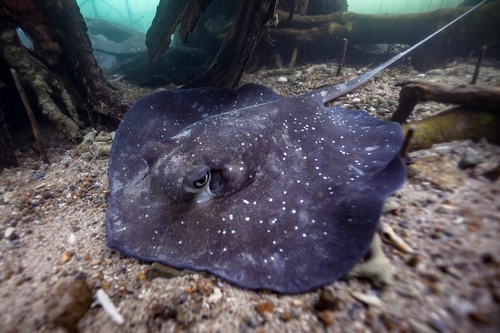
Mangrove Whipray
Urogymnus granulatus
A striking inhabitant of the tropical shallows, the Mangrove Whipray is easily identified by its polka-dotted back and stark white tail. This resilient ray bridges the gap between mysterious mangrove roots and vibrant coral reefs.
Quick Identification
Size
Disc width up to 1.4 m (4.6 ft); total length can exceed 2 m (6.6 ft) including the tail
Colors
Dark charcoal to brownish-grey upper disc with numerous small white spots or flecks; white underside; tail is notably white past the stinging spine
Key Features
- Thick, oval-shaped pectoral disc
- White flecks across a dark grey back
- Distinctive white whip-like tail tip
- Sturdy, venomous tail spine located near the base
When You’ll See Them
Geographic range
Where Does the Mangrove Whipray Live?
The Mangrove Whipray is a master of the Indo-Pacific shallows, boasting a vast range that stretches from the warm waters of the Red Sea and East Africa across to the tropical reaches of Northern Australia and Micronesia. This species is predominantly found in coastal regions of countries like Indonesia, Thailand, and the Philippines, where the intersection of land and sea provides ample hunting grounds. While it is a native fixture of these tropical ecosystems, no significant introduced populations have been recorded, making it a true sentinel of the pristine Indo-Pacific coastal belt.
Basemap © OpenStreetMap contributors
Behavior
The Mangrove Whipray is a sophisticated benthic predator known for its distinct habitat transitions throughout its life cycle. Juveniles are almost exclusively found in the tangled roots of mangrove forests and shallow estuaries, using these complex environments as nurseries to avoid larger predators. As they mature, these rays venture further out into deeper waters, though they rarely leave the coastal shelf, preferring the sandy bottoms and rubble-strewn floors of coral reef lagoons.
While generally solitary, they are occasionally seen in small, loose groups resting on the seabed or following one another during mating season. They are relatively docile around humans but possess a venomous tail spine for defense; however, they prefer to swim away or bury themselves in the sand when threatened. Their daily routine is largely dictated by the tides, moving into the intertidal zones during high tide to feast on the abundance of life brought in by the rising water.
EverydayEarth exclusive
Camera Tips
Capturing the Mangrove Whipray requires a specialized approach since they are entirely aquatic. If you have a 'coastal backyard' or access to a mangrove creek, an underwater trail camera or a waterproof action camera on a time-lapse setting is essential. Mount your camera on a weighted base or a low-profile tripod and place it in the shallow intertidal zone during low tide, ensuring it is positioned to face a clearing between mangrove roots or a known sandy 'highway' where rays are frequently seen passing through.
To attract these intelligent rays, you can use a perforated PVC bait tube filled with smashed crabs or oily fish like mackerel. Secure the bait tube within the camera's field of view, ideally 2 to 3 feet away, to encourage the ray to linger and forage in front of the lens. The best time for activity is during the incoming 'push' of the tide, especially when it coincides with dawn or dusk, as the rays move into the shallows to hunt. Natural light is best for capturing the white flecks on their dark disc, so aim for shallow depths where sunlight can penetrate effectively.
Settings are crucial for underwater clarity and capturing the ray's grace. Use a high frame rate (60fps) if your camera supports it, as the undulating movement of the ray's pectoral fins is best captured smoothly. If your camera has a 'scout' mode, set it to trigger on motion, but be aware that floating seagrass or debris in mangroves can cause false triggers; a time-lapse mode (one photo every 10–30 seconds) is often more reliable for aquatic environments. Ensure your lens is treated with an anti-fog solution, as temperature changes between the air and water can easily cloud your footage during deployment.
Similar Species
Species that look similar or are commonly confused with Mangrove Whipray.
Frequently Asked Questions
Record Mangrove Whipray at your habitat
Connect a camera to start building your own species record — AI identifies every visitor automatically.