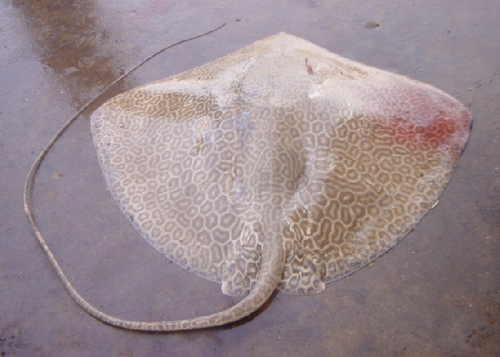
Honeycomb Whipray
Himantura undulata
Discover the mesmerizing patterns of the Honeycomb Whipray, a master of camouflage in the Indo-Pacific's shallow seas. With its striking leopard-like rings and elegant glide, this endangered ray is a crown jewel of coastal biodiversity.
Quick Identification
Size
Disc width up to 1.3 m (4.3 ft); total length including tail can exceed 3 m (10 ft).
Colors
Dorsal surface features a beige or yellow background covered in large, dark brown rings or 'honeycomb' reticulations; juveniles have solid dark spots.
Key Features
- Striking dorsal pattern of large dark brown rings and thin yellow lines
- Large diamond-shaped disc with a projecting, pointed snout
- Long, whip-like tail that lacks fin folds
When You’ll See Them
Geographic range
Where Does the Honeycomb Whipray Live?
Native to the vast waters of the Indo-Pacific, the Honeycomb Whipray occupies a core range that stretches from the eastern coast of India through the Malay Archipelago to northern Australia. These rays are frequently found in the coastal zones of Thailand, Indonesia, and Vietnam, where they prefer the warm, shallow waters of the continental shelf. While they are not known to be an introduced species elsewhere, their presence is a vital indicator of the health of tropical marine ecosystems across South and Southeast Asia.
Basemap © OpenStreetMap contributors
Behavior
The Honeycomb Whipray is a master of camouflage, typically found gliding gracefully over the seafloor or resting partially buried in the sand. During the day, they are often seen in shallow waters where the dappled sunlight mimics their intricate dorsal patterns, making them nearly invisible to predators. Though they are generally solitary hunters, they are not strictly territorial and may congregate in areas with high prey density.
When interacting with humans, these rays are shy and will usually swim away if disturbed. However, like most stingrays, they possess a venomous spine at the base of their tail for defense. They are not aggressive by nature, but their habit of resting in shallow, turbid water means that waders should be cautious to avoid accidentally stepping on them.
EverydayEarth exclusive
Camera Tips
Capturing a Honeycomb Whipray requires specialized underwater housing or a waterproof trail camera capable of withstanding saltwater corrosion. For the best results, mount your camera to a weighted base or a stable reef structure at a height of 12 to 24 inches above the sandy floor. Angling the lens slightly downward at a 15-degree angle ensures you capture the intricate honeycomb patterns on their dorsal side as they glide past or forage in the substrate.
While baiting isn't always necessary in high-traffic areas, placing a small perforated canister of crushed oily fish or shrimp nearby can lure them into the camera's frame as they use their electroreceptors to scan for prey. Since these rays are most active during the transition between day and night, ensure your camera has high-quality low-light sensors or infrared capabilities that won't startle the animal. Set your trigger speed to its fastest setting, as their gliding motion can be surprisingly quick when they catch a current.
Seasonal clarity is crucial; aim to deploy your camera during the dry season when water turbidity is lowest to ensure the AI can distinguish the ray's unique reticulated markings from the surrounding sand. Regularly check the lens for 'biofouling' or algae growth, which happens quickly in warm tropical waters. Using a wide-angle lens is highly recommended to capture the full span of their impressive 4-foot disc width without cropping out the tail.
Similar Species
Species that look similar or are commonly confused with Honeycomb Whipray.
Frequently Asked Questions
Record Honeycomb Whipray at your habitat
Connect a camera to start building your own species record — AI identifies every visitor automatically.