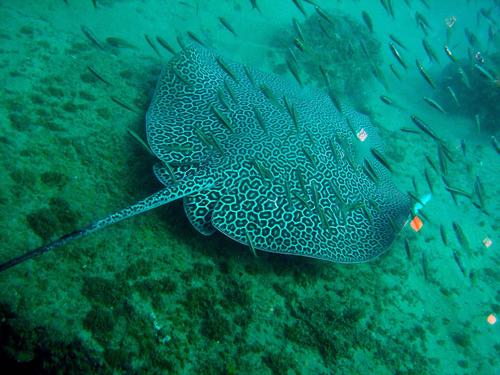
Leopard Whipray
Himantura leoparda
Adorned with striking leopard-like rings, this graceful stingray is a master of disguise in the tropical Indo-Pacific. Gliding silently over sandy floors, the Leopard Whipray is one of the ocean's most mesmerizing and elusive bottom-dwellers.
Quick Identification
Size
Disc width up to 1.8 m (5.9 ft); total length including the tail can reach over 4 m (13 ft)
Colors
Yellowish-brown base color with a complex pattern of dark brown rings and spots; white or cream underside
Key Features
- Broad diamond-shaped pectoral disc with a sharply pointed snout
- Distinctive leopard-like pattern of dark rings on the dorsal surface
- Extremely long, thin, whip-like tail without any dorsal or ventral fin folds
- A single row of enlarged, heart-shaped dermal denticles along the spine
When You’ll See Them
Geographic range
Where Does the Leopard Whipray Live?
The Leopard Whipray is native to the warm, tropical waters of the central Indo-West Pacific. Its presence is most concentrated within the Coral Triangle, extending from the Andaman Sea across Southeast Asia to the northern coasts of Australia and New Guinea. This species thrives in the shallow continental shelves of countries such as Thailand, Malaysia, Indonesia, and the Philippines, where it sticks to depths shallower than 70 meters.
Basemap © OpenStreetMap contributors
Behavior
The Leopard Whipray is a master of benthic camouflage, spending much of its life resting on the seafloor. It often uses its pectoral fins to fan sand over its back, leaving only its eyes and spiracles (breathing holes) exposed. This allows it to remain hidden from large sharks while waiting for an opportunity to strike at passing prey. It is a solitary creature, though several individuals may congregate in areas with abundant food sources or during mating cycles.
In terms of interaction with humans, the Leopard Whipray is generally wary and will glide away if it senses heavy vibrations or bubbles from divers. However, because it inhabits shallow coastal waters, it is frequently encountered by artisanal fishers. While not aggressive, it possesses a sharp, venomous spine at the base of its tail used strictly for self-defense. When hunting, it uses 'electroreception'—the ability to sense the tiny electrical fields produced by other living animals—allowing it to find prey hidden deep beneath the sediment.
EverydayEarth exclusive
Camera Tips
To capture high-quality footage of a Leopard Whipray, you will need a specialized underwater camera setup. Since these rays are bottom-dwellers, the best results come from mounting your camera to a weighted base or a low-profile underwater tripod. Position the camera on a sandy patch near the edge of a coral reef or a known seagrass bed. Aim the lens horizontally, just a few inches off the seabed, to capture the ray's stunning 'leopard' pattern as it glides directly over the lens.
Because the Leopard Whipray is easily spooked by movement, 'set-and-forget' underwater trail cameras or stationary action cameras are superior to handheld units. Look for 'feeding pits'—circular depressions in the sand where a ray has recently puffed water to uncover crustaceans. Placing your camera near these active foraging sites during the early morning or late afternoon light will significantly increase your chances of a sighting. Avoid using high-intensity artificial lights if possible, as the glare can wash out the intricate ring patterns on their skin; natural filtered sunlight in shallow water (under 10 meters) provides the best color accuracy.
Ensure your camera is set to a high frame rate, such as 60fps or 120fps. The movement of a Leopard Whipray is incredibly fluid and rhythmic; high-speed recording allows you to slow down the footage in post-production to appreciate the hypnotic undulation of its pectoral fins. If your camera has a motion-detect feature, test the sensitivity beforehand, as the ray’s camouflage is so effective that some sensors may struggle to distinguish the animal from the shifting sandy background.
Similar Species
Species that look similar or are commonly confused with Leopard Whipray.
Frequently Asked Questions
Record Leopard Whipray at your habitat
Connect a camera to start building your own species record — AI identifies every visitor automatically.