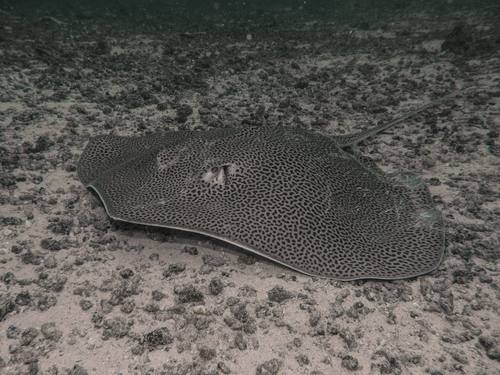
Reticulate Whipray
Himantura uarnak
With its mesmerizing leopard-like spots and a tail that seems to go on forever, the Reticulate Whipray is a masterpiece of marine camouflage and grace.
Quick Identification
Size
Disc width up to 2 m (6.6 ft); total length including the tail can reach up to 4.5 m (15 ft) or more.
Colors
Dorsal surface features a complex 'honeycomb' or reticulated pattern of dark brown to black spots on a beige, yellow, or sandy-brown background; the underside is uniform creamy white.
Key Features
- Intricate dark honeycomb or leopard-like spots on a lighter background
- Extremely long, whip-like tail that can be three times the body length
- Diamond-shaped pectoral fin disc with slightly pointed tips
- Absence of fin folds on the tail, distinguishing it from many other stingrays
When You’ll See Them
Geographic range
Where Does the Reticulate Whipray Live?
Where Does the Reticulate Whipray Live? This species is widely distributed throughout the tropical and subtropical waters of the Indo-Pacific. It is natively found from the eastern coast of South Africa and the Red Sea, stretching across the Arabian Sea to the shores of India, Southeast Asia, and as far south as northern Australia. In a fascinating display of range expansion, it has also become a Lessepsian migrant, traveling through the Suez Canal to establish populations in the eastern Mediterranean Sea along the coasts of Israel, Lebanon, and Turkey.
Basemap © OpenStreetMap contributors
Behavior
The Reticulate Whipray is a largely solitary bottom-dweller that spends a significant portion of its day resting on the seafloor. It is famous for its 'pit-digging' behavior, where it uses its pectoral fins to excavate depressions in the sand to uncover buried prey or to create a camouflaged resting spot. While they appear docile and often glide slowly across the substrate, they are capable of powerful bursts of speed when threatened or when chasing active prey.
Socially, they are usually seen alone, but they may congregate in high numbers in shallow estuaries or lagoons during the breeding season or in areas with high food density. They are generally wary of humans and will usually swim away if disturbed, but they should be treated with respect due to the long, venomous spine located at the base of their tail which they use for defense against predators like hammerhead sharks.
EverydayEarth exclusive
Camera Tips
Capturing a Reticulate Whipray requires a specialized approach since they are entirely aquatic. For those with waterfront properties or docks, the best setup involves an underwater action camera or a waterproof trail camera housed in a marine-grade casing. Mount the camera approximately 1 to 2 feet above the seabed, angled slightly downward to capture the stunning honeycomb pattern on the ray's back as it passes through the frame. Use a weighted base or secure the mount to a pier piling to ensure the camera remains stable against tides and currents.
To increase your chances of a sighting, place the camera near a natural 'bottleneck' such as a channel between sandbars or near the edges of a seagrass bed. You can attract these rays by using a perforated bait box filled with crushed shellfish or oily fish scraps. The rays' keen sense of smell and electroreception will lead them directly to the bait, often resulting in close-up footage of their unique undulating swimming motion and foraging behavior.
Visibility is key, so aim for days with calm seas and minimal sediment runoff. If your camera setup supports it, use a wide-angle lens to capture the ray's full 2-meter width and its exceptionally long tail. Since these rays are active day and night, a camera with good low-light sensitivity or a motion-activated red-light LED will allow you to see their nocturnal foraging without startling them or washing out the intricate patterns on their skin.
Similar Species
Species that look similar or are commonly confused with Reticulate Whipray.
Frequently Asked Questions
Record Reticulate Whipray at your habitat
Connect a camera to start building your own species record — AI identifies every visitor automatically.