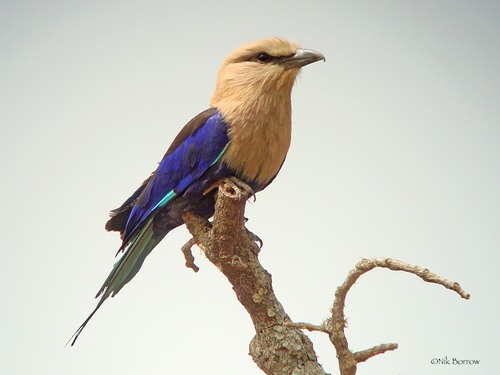
Blue-bellied Roller
Coracias cyanogaster
A flash of electric blue against the African savanna, the Blue-bellied Roller is a master of aerial acrobatics and a bold hunter of the wooded grasslands.
Quick Identification
Size
28–30 cm (11–12 in) long, plus 6 cm tail streamers; wingspan 50–60 cm (20–24 in); weight 110–150g (3.9–5.3 oz)
Colors
Creamy-white to olive-tinted head and mantle; vibrant electric blue belly, rump, and wings; dark flight feathers; bright blue tail with elongated outer feathers
Key Features
- Distinctive electric blue underparts
- Long, thin tail streamers (forked tail)
- Cream or light-tan head and upper back
- Heavy, dark, hooked beak
When You’ll See Them
Geographic range
Where Does the Blue-bellied Roller Live?
The Blue-bellied Roller is native to the African continent, where it occupies a narrow, latitudinal belt across West and Central Africa. Its core range extends from Senegal and Gambia eastward through Guinea, Sierra Leone, Ivory Coast, and Nigeria, reaching as far as the Central African Republic and the northeast Democratic Republic of the Congo. It is a specialist of the 'Guinea Savanna' zone, thriving where the forest meets the grassland.
Basemap © OpenStreetMap contributors
Behavior
The Blue-bellied Roller is a bold and conspicuous bird often seen occupying high-visibility perches like telephone wires, dead tree branches, or the tops of palms. From these vantage points, they act as sit-and-wait predators, scanning the ground for movement before launching into a steep, direct dive to snatch prey. They are highly territorial, especially during the breeding season, and will aggressively chase off larger birds or even small raptors that venture too close to their nesting site.
The species gets its name from its spectacular aerial courtship displays, during which it flies to great heights and then plunges toward the earth in a series of fast, erratic rolls and turns. These displays are almost always accompanied by loud, rasping calls that can be heard from a significant distance. While they are generally solitary or found in pairs, they may congregate in small groups near bushfires to feast on insects fleeing the flames.
EverydayEarth exclusive
Camera Tips
To capture high-quality images of the Blue-bellied Roller, you should identify their favorite 'sentinel' perches. These birds are creatures of habit and will return to the same exposed branch or fence post day after day to hunt. Mount your AI-powered camera on a nearby tree or a sturdy pole, aimed slightly upward toward these high perches. If the perch is a dead branch against a clear sky, you will get spectacular silhouette shots at dawn or vibrant, saturated colors during the midday sun.
While they are not attracted to traditional seed feeders, they are highly responsive to habitat features. In a backyard or farm setting, maintaining a patch of very short, mown grass can attract them, as it makes it easier for them to spot the large insects they prey upon. Positioning a camera low to the ground near a known hunting area can capture dramatic 'strike' photos as the bird dives toward the grass. Ensure your camera's trigger speed is set to its fastest possible interval, as their dives are incredibly quick.
The electric blue feathers of this species are highly reflective and can 'wash out' in harsh, direct sunlight. For the best results, configure your camera to be most active during the golden hours—shortly after sunrise and before sunset. If you are using a trail camera with adjustable settings, a slight underexposure can help preserve the deep, rich blues of the belly and wings. Because these birds are resident and territorial, once you find a pair, you can reliably capture them throughout the year by keeping your camera in a fixed location.
Similar Species
Species that look similar or are commonly confused with Blue-bellied Roller.
Frequently Asked Questions
Record Blue-bellied Roller at your habitat
Connect a camera to start building your own species record — AI identifies every visitor automatically.