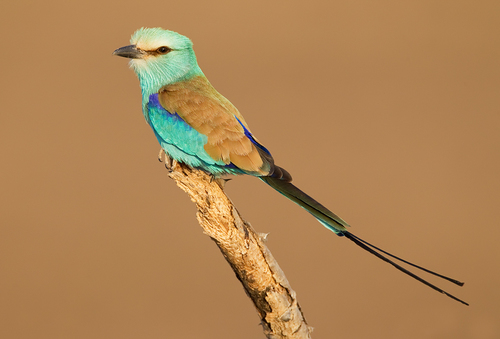
Abyssinian Roller
Coracias abyssinicus
A flash of sapphire and turquoise against the dusty Sahel, the Abyssinian Roller is a master of the aerial hunt. With its elegant tail streamers and fearless attitude, this stunning bird brings a touch of royal blue to the open African savanna.
Quick Identification
Size
Length 28-30 cm (11-12 in), with tail streamers adding another 12 cm (5 in); Weight 100-140g (3.5-4.9 oz)
Colors
Turquoise-blue head and underparts, sand-brown mantle, dark blue wing coverts, and black outer tail streamers. Males and females look identical.
Key Features
- Two long, slender black tail streamers
- Vibrant turquoise-blue underparts contrasting with a brown back
- Heavy, hooked black bill
- Striking sapphire blue flight feathers visible in flight
When You’ll See Them
Geographic range
Where Does the Abyssinian Roller Live?
The Abyssinian Roller is a quintessential species of the African Sahel, inhabiting a broad, sun-drenched belt just south of the Sahara Desert. This vibrant bird makes its home across the continent from the Atlantic coast of Senegal and The Gambia, stretching eastward through Nigeria and Chad into the highlands of Ethiopia and Eritrea. Beyond the African mainland, they have also established a significant presence in the southwestern Arabian Peninsula, primarily within Yemen and Saudi Arabia, where they frequent dry, open landscapes similar to their native African haunts.
Basemap © OpenStreetMap contributors
Behavior
The Abyssinian Roller is a bold and conspicuous bird, often seen perched prominently on high vantage points such as telephone wires, dead tree branches, or fence posts. From these lookouts, they scan the ground for movement, performing a 'perch-and-pounce' hunting technique. They are highly territorial, especially during the breeding season, and are known for their spectacular aerial displays. These 'rolling' flights, which give the family its name, involve steep dives and fast side-to-side rolls accompanied by harsh, raucous calling.
These birds are remarkably fearless and are frequently attracted to bushfires. They will hover near the edge of the smoke and flames to snatch up fleeing insects that have been flushed out by the heat. While they are generally solitary or found in pairs, they may congregate in small groups where food is exceptionally abundant. Their interaction with humans is mostly passive; they have adapted well to agricultural landscapes and often use man-made structures as hunting perches.
EverydayEarth exclusive
Camera Tips
To capture the Abyssinian Roller on camera, focus on their preferred 'perch-and-pounce' hunting style. Identify a solitary dead branch, a fence post, or even a tall tripod placed in an open area of your yard or field. Position your camera about 5 to 10 feet away from the perch, aimed slightly upward to capture the bird against the sky or a distant background. Since they prefer high vantage points, mounting your camera on a pole or a high fence line can yield much more natural results than ground-level setups.
Because their brilliant blue plumage relies on structural coloration, lighting is everything. Set your camera to face away from the sun (north-facing is often best) so the light hits the bird directly, making those turquoise and sapphire tones pop. Early morning or late afternoon light provides a warm glow that complements their brown backs while making the blue feathers appear incredibly luminous. Avoid deep shade, as the bird can look surprisingly dull without direct light.
Speed is essential when dealing with rollers. They are lightning-fast when they dive for prey. Use a high shutter speed (at least 1/1000s if your camera allows) and enable burst mode or 'Photo Burst' in your AI camera settings. This will increase your chances of catching the moment they take flight or the exact second they land back on the perch with a grasshopper in their beak. If your camera has a 'pre-roll' feature, enable it to catch the action leading up to the trigger.
While they don't typically visit traditional bird feeders, you can entice them by maintaining a 'wild' patch of grass that attracts large insects. They are also attracted to water in dry environments. A elevated bird bath near a high perch can be a magnet for them during the heat of the day. Ensure the camera is protected from the sun to prevent overheating during the long daytime hours when these birds are most active.
Similar Species
Species that look similar or are commonly confused with Abyssinian Roller.
Lilac-breasted Roller
Features a purple/lilac breast and throat; lacks the solid blue underparts of the Abyssinian Roller.
European Roller
Similar blue coloration but lacks the long tail streamers entirely and has a thicker neck.
Blue-bellied Roller
Has a dark blue belly and cream-colored head, contrasting with the Abyssinian's pale blue head and breast.
Frequently Asked Questions
Record Abyssinian Roller at your habitat
Connect a camera to start building your own species record — AI identifies every visitor automatically.