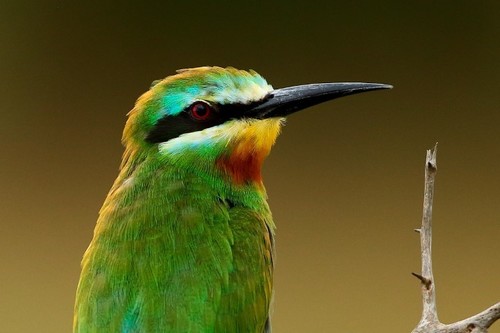
Blue-cheeked Bee-eater
Merops persicus
A shimmering emerald of the sky, the Blue-cheeked Bee-eater is a master of aerial acrobatics and a brilliant visitor to the world's warmer regions. With its striking blue accents and elegant tail streamers, it turns every insect hunt into a display of grace.
Quick Identification
Size
Length: 28–31 cm (11–12.2 in); Wingspan: 46–49 cm (18.1–19.3 in); Weight: 38–56 g (1.3–2.0 oz)
Colors
Predominantly bright emerald green with a bronze-yellow throat, a black eye-mask, and distinctive blue patches on the cheeks and forehead.
Key Features
- Bright emerald green plumage with blue cheek patches
- Long, slender black bill and black eye-mask
- Distinctive elongated central tail feathers called streamers
- Yellowish-rufous throat transitioning to green body
When You’ll See Them
Geographic range
Where Does the Blue-cheeked Bee-eater Live?
The Blue-cheeked Bee-eater is native to a wide belt spanning Northern Africa and the Middle East, reaching from eastern Turkey and Iraq through Kazakhstan and into the Indian subcontinent. Most populations are strongly migratory, traveling south to spend the winter months in tropical Africa, though a dedicated population remains year-round in the semi-arid Sahel region. While primarily an Afro-Asian species, they are occasionally spotted as rare visitors in parts of Southern Europe like Italy and Greece.
Basemap © OpenStreetMap contributors
Behavior
Blue-cheeked Bee-eaters are social and highly agile birds, often seen perched on telegraph wires, fence posts, or high bare branches. From these vantage points, they perform stunning aerial sorties to snatch insects from the air. Their flight is a graceful display of skill, characterized by alternating series of rapid wingbeats and long, effortless glides. They are gregarious by nature, frequently nesting in loose colonies and communicating with a distinct, liquid 'pruuk' or 'drruut' call that can be heard from a distance.
Like their relatives, they have developed a specialized way of handling stinging prey. After catching a bee or wasp, the bird returns to its perch and repeatedly strikes the insect's head against the surface to stun it, then rubs the abdomen against the perch to remove the stinger and venom. While they generally avoid direct human contact, they are often found near human-altered landscapes like irrigated farms and orchards where insects are plentiful.
EverydayEarth exclusive
Camera Tips
To capture the stunning iridescent green of the Blue-cheeked Bee-eater, position your camera to face prominent, solitary perches. These birds favor bare branches, fence lines, or even tall reeds near water bodies. They are creatures of habit and often return to the same lookout spot after a hunting flight. Setting your camera at a slight upward angle will help silhouette their elegant tail streamers against the sky or a soft-focus background, making for a much more professional-looking shot.
Because these birds are insect specialists, the best way to attract them to your yard is to cultivate a habitat that supports dragonflies and bees. Avoid pesticides and plant native flowering shrubs. Providing a water source, such as a large birdbath or a shallow pond, is also a great way to lure them in, as they often drop down for a quick drink or a splash-bath during the heat of the day. Unlike songbirds, they won't come to seed or suet feeders, so focus your camera placement on these natural activity hubs instead.
For the best AI triggers, set your camera to its most sensitive motion setting and use a high shutter speed if available, as their movements are lightning-fast. The 'golden hours'—shortly after sunrise and before sunset—provide the ideal lighting to catch the flash of blue on their cheeks. If you are using a trail camera, mount it about 5 to 7 feet off the ground on a sturdy post facing a known perching branch about 10 to 15 feet away to ensure the bird remains in focus during its stay.
Similar Species
Species that look similar or are commonly confused with Blue-cheeked Bee-eater.
Frequently Asked Questions
Record Blue-cheeked Bee-eater at your habitat
Connect a camera to start building your own species record — AI identifies every visitor automatically.