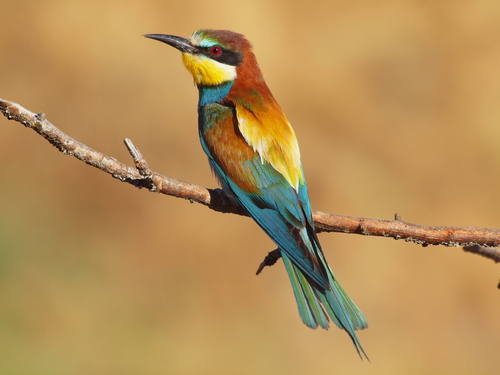
European Bee-eater
Merops apiaster
The European Bee-eater is a living rainbow, a migratory masterpiece that brings a touch of the tropics to the European countryside with its dazzling colors and expert aerial displays.
Quick Identification
Size
Length: 27–29 cm (10.6–11.4 in); Wingspan: 44–49 cm (17.3–19.3 in); Weight: 50–70 g (1.8–2.5 oz)
Colors
Highly multicolored with a chestnut-brown crown and back, golden-yellow throat, turquoise-blue underparts, and green wings. Features a distinct black eye-stripe and a yellow scapular patch.
Key Features
- Bright yellow throat with a narrow black border
- Chestnut-red crown and upper back
- Long, central tail feathers (streamers)
- Black, slightly decurved bill
- Vivid turquoise underparts
When You’ll See Them
Geographic range
Where Does the European Bee-eater Live?
The European Bee-eater is a wide-ranging traveler, primarily native to the warm regions of Southern and Central Europe, Northern Africa, and Western Asia. Its core breeding grounds stretch from the Iberian Peninsula through the Mediterranean and into the steppes of Kazakhstan. As a strongly migratory species, the majority of the population crosses the Mediterranean and Sahara to spend the winter in the tropical savannas of Sub-Saharan Africa, though a separate resident population exists in parts of Southern Africa.
Basemap © OpenStreetMap contributors
Behavior
European Bee-eaters are exceptionally social birds, known for their gregarious nature and the melodic 'pruuk-pruuk' calls they make while in flight. They are often seen in small family groups or larger colonies, perching together on telephone wires, fences, or the bare branches of trees. These birds are masters of the air, performing graceful loops and glides to snatch insects directly out of the sky.
One of their most fascinating behaviors is the way they handle stinging insects. After catching a bee or wasp, the bird returns to its perch and beats the insect against the wood to stun it, then rubs the abdomen against the branch to discharge the venom sac and remove the stinger before swallowing. They are also colonial nesters, working together to tunnel into sandy banks or cliffs where they raise their young in relative safety.
EverydayEarth exclusive
Camera Tips
To capture the stunning iridescent plumage of the European Bee-eater, camera placement is everything. These birds love 'lookout' perches. If you have a backyard near their habitat, try placing a dead branch or a tall wooden stake in a clear, open area. Mount your camera at roughly eye-level with the perch (about 1.5 to 2 meters) and angle it to ensure the background is distant, which will create a beautiful blur (bokeh) that makes the bird's colors pop.
Lighting is the most critical factor for these birds. Position your camera so the sun is behind it, especially during the 'golden hours' of early morning or late afternoon. This direct light will catch the metallic sheen of their turquoise and gold feathers. Because Bee-eaters are fast and often perform quick 'sallying' flights to catch bugs, use a high shutter speed or a fast-trigger trail camera with a 'burst' mode to catch the moment they take off or land.
If you are setting up near a nesting bank, stay at a distance of at least 15 meters to avoid causing stress. Use a high-resolution camera that allows for digital zooming later. Avoid using any artificial baits or lures; instead, providing a water source like a birdbath or a small pond can be an excellent way to attract them for a drink or a quick dip. During the peak breeding months of June and July, look for activity around sandy embankments where you might catch them bringing food back to their burrows.
Similar Species
Species that look similar or are commonly confused with European Bee-eater.
Frequently Asked Questions
Record European Bee-eater at your habitat
Connect a camera to start building your own species record — AI identifies every visitor automatically.