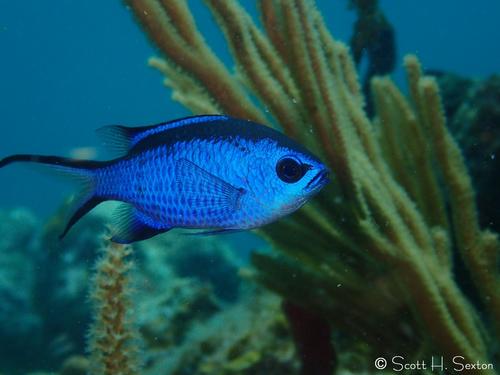
Blue Chromis
Azurina cyanea
The Blue Chromis is the vibrant, sapphire-colored heartbeat of the Caribbean reef, bringing the ocean to life with its shimmering schools and graceful movements.
Quick Identification
Size
Typically 7-13 cm (3-5 inches) in length; maximum recorded size is approximately 15 cm (6 inches).
Colors
Brilliant electric blue body with a blackish border along the dorsal fin and the outer edges of the tail fin.
Key Features
- Vivid neon blue coloration across the entire body
- Deeply forked, V-shaped tail with dark margins
- Slender, elongated oval body shape
- Small, upturned mouth adapted for plankton feeding
When You’ll See Them
Sightings on EverydayEarth
Jul 3, 2026
A Creole Wrasse swims across the upper portion of the frame, showing its characteristic dark-colored tail against its lighter blue body. Numerous small Blue Chromis are scattered throughout the water column, darting between the coral heads. The reef itself is densely populated with various corals, including sea fans and plumes that sway rhythmically with the ocean current.
Jul 3, 2026
A variety of tropical fish are active above a healthy coral reef. A Creole Wrasse is prominent in the upper water column, displaying its characteristic dark-to-light color transition. A terminal phase Bluehead Wrasse with its signature blue head and black banding swims through the mid-ground, while several small Blue Chromis dart about in the open water above the corals. The soft corals and fans sway gently in the current.
Jul 3, 2026
A vibrant coral reef scene shows a variety of fish active around the reef structure. A terminal phase Bluehead Wrasse swims prominently in the upper portion of the frame. Several Sergeant Majors are visible weaving through the sea fans and corals on the left, while schools of small Blue Chromis dart through the water column. The reef is rich with diverse coral species, including sea fans and brain corals, swaying gently in the current.
Jul 3, 2026
A Creole Wrasse swims through the upper water column while several small Blue Chromis hover in a group just above the coral reef. The reef is active with various species of coral and sea fans swaying gently in the current.
Jul 3, 2026
A vibrant underwater scene features a Blue Chromis swimming through the clear blue water column above the reef. Near the coral heads and sea fans, several small Caribbean Bluehead Wrasses are seen darting about, likely foraging among the diverse coral species and sponges.
Jul 3, 2026
A diverse coral reef scene teeming with life. A terminal phase male Bluehead Wrasse and a Creole Wrasse are seen swimming in the open water above the reef. Several small Blue Chromis are scattered throughout the scene, hovering near the safety of various coral species including sea fans, brain corals, and stony corals. The water is clear with bright afternoon sunlight filtering through.
Geographic range
Where Does the Blue Chromis Live?
The Blue Chromis is a signature species of the tropical Western Atlantic. Its range begins in the northern waters of Bermuda and extends down through the southern tip of Florida and the Florida Keys. From there, it is found throughout the entire Caribbean Sea, the Gulf of Mexico, and as far south as the northern coasts of South America, including Venezuela and Colombia. These fish are most prevalent in high-visibility reef environments where the water remains warm and nutrient-rich year-round.
Basemap © OpenStreetMap contributors
Recorded on EverydayEarth
Behavior
As dusk approaches or when a potential predator is detected, the entire school performs a coordinated retreat into the reef. They are particularly fond of branching corals, such as Staghorn coral, where they wedge themselves into the tight spaces between branches to sleep or hide. This dependency on coral structure makes them excellent indicators of reef health. In a backyard dock or marine observatory setting, they are curious but cautious, often the first to investigate a new structure but the quickest to dart away if they perceive a threat.
EverydayEarth exclusive
Camera Tips
Because water absorbs red light, a Blue Chromis can appear dull or grey at depths below 15 feet. To see their true electric blue, use a camera with a 'Dive Mode' or a red filter. If your backyard setup allows, adding a small, diffused underwater LED light can make their iridescent scales sparkle, but avoid harsh, direct beams which might spook them. High frame rates (60fps or higher) are recommended because these fish are constant, jittery movers; slower frame rates will result in a blue blur rather than a crisp image.
For the best AI detection, ensure your lens is kept free of algae. In tropical waters, biofouling can cover a lens in days. Use a soft brush or a specialized underwater housing with a wiper if possible. Setting your camera to trigger on motion is effective for this species, but because they school, you may end up with thousands of clips. A time-lapse setting of one photo every 30 seconds during peak daylight hours is often a better way to monitor their schooling patterns and population health without exhausting your storage.
Similar Species
Species that look similar or are commonly confused with Blue Chromis.
Frequently Asked Questions
Record Blue Chromis at your habitat
Connect a camera to start building your own species record — AI identifies every visitor automatically.